Saturday, June 25, 2022

Monday, June 20, 2022

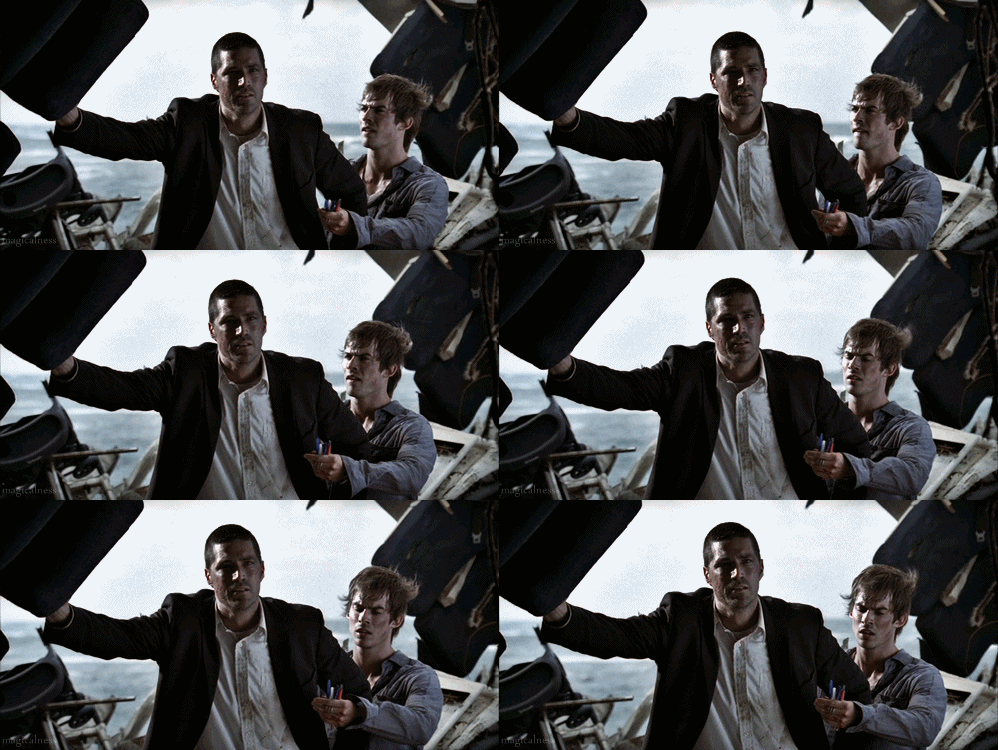
"LOST" RETROSPECT: (1.01-1.02) "The Pilot"


"LOST" RETROSPECT: (1.01-1.02) "The Pilot"

The pilot episode of some of my favorite television series have rarely impressed me . . . if not at all. There are a few exceptions to the rule. And one of those exceptions happened to the be pilot episode for ABC-TV's "LOST".

Created by J.J. Abrams, Jeffrey Leiber and Damon Lindelof, "LOST" aired on television for six seasons, between 2004 and 2010. As many fans know, "LOST" told about the survivors of a commercial passenger plane crash on a mysterious South Pacific island, while flying between Sydney and Los Angeles. While television viewers got to know these survivors during their time on the island, but also through flashbacks revealing their past. The series' first episode aired in two parts on September 22, 2004.

(1.01) "Pilot (Part 1)" introduced the series' leading character, a spinal surgeon named Dr. Jack Shephard, who wakes up in the middle of the jungle following the crash of Oceanic Airlines Flight 815. He stumbles onto the beach and finds the chaos left behind from Oceanic 815's crash. As everyone knows, the plane broke into three pieces before crashing on the island. Jack and most of the survivors ended upon with the fuselage. The cockpit and the plane's first-class section ended deep into the jungle with no survivors, save the pilot. And the tail section fell into the ocean on the other side of the island. Jack and some of the survivors like John Locke and Hugo "Hurley" Reyes help other passengers with injuries or dodging burning pieces. After helping some of the passengers, Jack goes to another part of the beach to tend to his own injury, when he meets Kate Austen. She sews up his injury, while the two bond. Many other things occur during the episode. Survivors either form friendships or get on each others' nerves. During their first night on the beach, everyone becomes unnerved by sounds of a monster deep in the jungle. The following day, Jack heads toward the cockpit to retrieve the plane's transceiver and is accompanied by Kate and musician Charlie Pace. They retrieve the transceiver and encounter the badly injured pilot, who informs them that the plane had lost radio contact six hours into the flight and veered off course. Before he can share any further information, he is seized by a strange being and killed. Jack, Kate and Charlie make a run for it.

(1.02) "Pilot (Part 2)" continue Jack, Kate and Charlie's flight from the monster that killed the pilot. During their absence, the dog of 10 year-old survivor Walt Lloyd finds a pair of handcuffs. A Middle Eastern survivor name Sayid Jarrah comes under suspicion from a Southern-born passenger named "Sawyer". Jack and his two companions make it back to the beach with the transceiver. Sayid, Kate, "Sawyer", Charlie and a step-brother-sister team named Boone Carlyle and Shannon Rutherford trek to the high ground to use the transceiver. Instead of contacting help, they manage to interpret a message sent earlier by a French woman on the island. One of the badly wounded survivors on the beach turn out to be a U.S. marshal demanding the whereabouts of his prisoner, a woman. Flashbacks reveal that the prisoner is Kate.

I will not deny that "LOST" is one of my favorite television series. It is not on my list of the top ten favorite shows. But it is on my list of top twenty favorites. Despite my favoritism toward "LOST", I cannot deny that it also possessed some seriously flawed writing. But it was not on display in the two-part pilot. Well . . . somewhat. A few of the occurrences in this episode ended up contradicting the series' future narrative.

It is ironic that the first villainous character to make his/her appearance in the series turned out to be the main villain - the Smoke Monster aka the Man in Black. The survivors heard its "roar" during their first night on the island. And he killed the Oceanic 815's pilot while the latter discussed the plane's location with Jack and Kate. In fact, the Smoke Monster killed another survivor in an early Season Three episode - Mr. Eko. While many fans are still debating the reason behind the MIB's murder of Mr. Eko, no one has figured out why the pilot was killed. Especially after Season Six revealed the list of candidates for the island's new caretaker. I suspect that the MIB was simply being portrayed as a supernatural monster before the writers had decided to portray him as a villain with a purpose.

I have two more complaints about the episode. Some of the characterizations struck me as one-dimensional. This was especially the case for Shannon Rutherford, who was portrayed as some bitchy Valley Girl; Jin Kwon, who was written as a cliché of the oppressive Asian husband; Sun Kwon, who was portrayed as the typically oppressed Asian wife; and James "Sawyer" Ford, who was not only unlikable, but also the one-dimensional Southern white male. In Sawyer's case, not only was his character portrayed in the worst clichéd manner possible, poor Josh Holloway was stuck with some pretty bad dialogue - especially in Part 2. He fared a lot better as the series progressed. Speaking of dialogue - yeech! Yes, I thought it was pretty bad. It was more than bad. I found it somewhat infantile and unmemorable.

Fortunately, the good outweighed the bad. Despite some of the one-dimensional characterization and bad dialogue, there were some pretty good performances. For me, one of the best performances came from Matthew Fox, who dived right into the role as the series' lead character, Dr. Jack Shephard. Fox gave early hints of the complicated and deeply flawed character later revealed in future episodes. Fox's early revelation of Jack's flaws must have been subtle, for the later revelation of his flaws seemed to have taken many by surprise. Dominic Monaghan gave a funny and charming performance as the drug-addicted musician, Charlie Pace. And yet, his performance was skillfully shaded with hints of his character's drug addiction. Thanks to Naveen Andrews' subtle, yet intense performance and good writing, the character of Sayid Jarrah rose above the usual clichés featuring Middle Eastern characters. Emilie de Ravin was a delight as the pregnant Australian survivor, Claire Littleton. As for Evangeline Lilly, she did a pretty good job as Kate Austen, the survivor trying to hide her status as a Federal prisoner. However, I had some difficulty accepting her as the take charge type, as the script tried to portray her in Part 2. Terry O'Quinn was perfectly mysterious as John Locke, but viewers had to wait for another two episodes before he began to shine in the role. And Harold Perrineau gave a skillful performance as Michael Dawson, the inexperienced father of 10 year-old survivor, Walt Lloyd.

I felt that the narrative for "The Pilot", which was written by Abrams and Lindelof, proved to be a well-written adventure. The story covered all of the elements for a story about survivors on a tropical island. The addition of the Smoke Monster injected a little horror and a great deal of mystery that would become the series' hallmark. One of the aspects of "The Pilot" that I found particularly interesting was that it started with a close-up of Jack Shephard's eye - post crash. In other words, this story did not start with the crash. Audiences were not treated to scenes aboard Oceanic Flight 815 and the actual crash, except during flashbacks. Very unusual. There were other scenes that I still find fascinating after nine years. My God! Has it been nine years? Those scenes include Jack, Kate and Charlie's escape from the cockpit, following the pilot's death; the discovery of Danielle Rousseau's message in Part 2; the encounter with the polar bear; and the survivors' first awareness of the Smoke Monster's existence. But the one scene that many consider outstanding - including myself - is that opening shot of the fuselage wreckage on the beach and the chaos that surrounded it. I must admit that not only did J.J. Abrams really outdid himself in this particular scene, it is probably one of his best directed sequences in his entire career.

Despite a few hiccups regarding dialogue and some one-dimensional characterizations, "LOST" provided one of the best series openings I have ever viewed on television, thanks to some superb direction by J.J. Abrams, a damn fine cast and a well written teleplay. It is a pity that the series has never been able to maintain such excellent consistency during the rest of its six seasons on the air.


Friday, June 17, 2022

"THE INFORMANT!" (2009) Review


"THE INFORMANT!" (2009) Review

As a rule, I am not particularly fond of whistleblower films. I find them rather boring and unoriginal. Then I saw Steven Soderbergh's 2009 movie, "THE INFORMANT!" and concluded there might be one whistleblower film that I do like.

Based on true events and the 2000 non-fiction book, ”The Informant”, by journalist Kurt Eichenwald, the movie is about Mark Whitacre, a rising star at Decatur, Illinois based Archer Daniels Midland (ADM) in the early 1990s who wound up blowing the whistle on the company’s price-fixing tactics, only after his wife forced him to. Soderbergh cast Matt Damon as Whitacre and Scott Bakula as FBI Special Agent Brian Shephard, the man to whom he ratted out ADM.

The movie began in 1992 when the FBI was brought in to investigate a possible case of corporate espionage against ADM. The espionage case later was found to be groundless, but during their investigation, Mark Whitacre, under pressure from his wife, told an FBI agent named Brian Shephard that he and other ADM executives were involved in a multinational conspiracy to control the price of lysine. So far, this plot struck me as no different than any other whistleblower movie. But what made ”THE INFORMANT!” unique to me was the character of said whistleblower – Mark Whitacre. The movie’s first half portrayed him as an eccentric man and enthusiastic executive who seemed reluctant to expose his superiors at ADM. But he eventually dedicated himself into assisting the FBI into spending years in gathering evidence by clandestinely taping the company’s activity in business meetings at various locations around the globe such as Tokyo, Paris, Mexico City, and Hong Kong, eventually collecting enough evidence of collaboration and conspiracy to warrant a raid. Following the raid, it all went downhill for Whitacre. The stress of being the FBI’s mole for three years led him to react to the media in a bizarre manner. More importantly, the FBI and the public discovered that Whitacre had embezzled millions of dollars from ADM.

When I first saw the billboards for ”THE INFORMANT!”, I thought it would be some kind of espionage film like the Jack Ryan novels or something like 1974’s ”THE CONVERSATION”. I eventually learn that the movie might have more to do with industrial espionage . . . and the fact that it was another whistleblower film. Why I did not bother to skip this film upon hearing this, I do not know. Perhaps I was willing to give it a chance due to the fact that Soderbergh and Damon (who did the three ”OCEAN’S ELEVEN” movies) were working together, again. And you know what? I am so glad that I gave it a chance. What started out as an amusing, yet detailed account of Whitacre’s years as a whistleblower for the FBI, ended in a chaotic character study of a very intelligent man who turned out to be a chronic liar and embezzler. As much as I enjoyed the movie’s first half, I really enjoyed the second half that exposed Whitacre’s crimes. The plot – or should I say Whitacre’s character – began to spiral out of control once the whistleblower tried to deflect himself from fraud charges in hilarious ways. By the time the movie ended, I did not know whether to be astounded or amused by how it all fell apart for Whitacre.

”THE INFORMANT!” featured a pretty good solid cast that included Scott Bakula as the long suffering FBI agent Brian Shephard who had recruited Whitacre to act as an informant for his agency . . . and lived to regret it. Joel McHale portrayed his partner, the more outgoing FBI agent Robert Herndon. It was interesting to see comedians like Thomas F.Wilson, the Smothers Brothers – Tom and Dick, Allan Harvey, Patton Oswalt and Scott Adsit all in serious roles. I enjoyed Tony Hale’s performance as Whitacre’s first attorney, James Epstein. Watching his reaction to the growing chaos that seemed to surround Whitacre was rather funny. And Melanie Lynskey gave a strong performance as Whitacre’s wife, Ginger, who seemed to act as the whistleblower’s conscious and backbone. But who am I kidding? The movie is owned lock, stock and barrel by Matt Damon’s brilliant performance as Mark Whitacre. I cannot even describe how good he was in capturing this complex, deceiving and yet, sympathetic personality. I found it criminal that Damon was not nominated for an Academy Award nomination for his performance.

Do I have any quibbles about ”THE INFORMANT!”? Uh . . . I can only think of one or two complaints right now. I found Soderbergh’s cinematography rather uninspiring. Yep . . . that is what I had said. The film’s director had also acted as the photographer. And I found it dull and slightly metallic at times. If Soderbergh honestly considers himself a genuine cinematographer . . . well, I would suggest that he stick to directing and producing. And I must admit that right before the FBI had decided to arrest some of ADM’s executives, the pacing became so slow that it nearly dragged the film. Aside from those complaints, I really enjoyed this movie. But I must warn you . . . if you are expecting it to be another ”THE INSIDER” or ”DEFENSE OF THE REALM”, you are going to be sadly disappointed. ”THE INFORMANT!” struck me as possessing an unusual and highly original story for it to be viewed as another whistleblower film.


Sunday, June 12, 2022

"IRON MAN" (2008) Photo Gallery


Here is a gallery of photos from "IRON MAN", the 2008 movie based upon the Marvel comic hero. Directed by Jon Favreau, the movie starred Robert Downey Jr. as Tony Stark aka Iron Man:


"IRON MAN" (2008) Photo Gallery


Saturday, June 11, 2022

"Buffy's Relationship With the Scoobies"


I have something of a problem with Buffy's relationship with the Scoobies:


"BUFFY'S RELATIONSHIP WITH THE SCOOBIES"

I am watching the Season Three episode, (3.07) "Revelations" right now. I am watching the scene in which the Scoobies reveal to Buffy that they know that Angel is still alive, and she had been keeping his presence a secret from them. Apparently, Xander had decided to spy on Buffy, due to her secretive nature and found her kissing Angel.

Now, I realize that they had a right to be angry that she failed to tell them about Angel being alive. But . . . God, this scene pissed me off! If there is one thing about Buffy's relationship with Giles and the Scoobies that has burned me is that she has allowed them to dictate her behavior and moral compass, due to her own fear of losing their friendship. Has Buffy ever put such pressure on Xander, Willow or Giles? I wonder. For years, they put her on this pedestal called "THE SLAYER" and rarely allow Buffy to be herself or have her own life.

Xander is the worst offender of them all. I do not know how this character came to be so beloved by the series' fans. Granted, Xander can be entertaining. But of all the characters, he is probably the most self-righteous of the bunch. And he has allowed his self-righteousness, along with his jealousy toward Buffy's relationships with both Angel and Spike to compromise his morals without any remorse. Good examples would be his lie to Willow about Buffy's wishes regarding Angel in (2.22) "Becoming - Part II" and his attempt to murder a chipped Spike in (6.18) "Entropy" for having sex with the fiancée he had dumped at the altar. Even in "Revelations", he was behaving in the most self-righteous manner about Buffy's lie regarding Angel . . . yet, at the same time, was kissing Willow behind Cordelia's back. Some would say that at least his infidelity with Willow was not a threat to anyone. But his and Willow's actions ended up hurting Cordelia in more ways than one.

The Scoobies' attitude toward Buffy reached its pinnacle in Season Six. In (6.01)"Bargaining - Part I", Willow, with Xander, Anya and Tara's assistance, brought Buffy back from the dead . . . without her consent or anything. An act that led to a yearlong depression for the Slayer. And they did this, because they needed "THE SLAYER". They believed that Sunnydale needed a Slayer. Despite the fact that Sunnydale had managed to exist without a Slayer for nearly a century before Buffy's arrival.

Is it any wonder why Buffy began to emotionally distance herself from her friends" in Season Seven?


Sunday, June 5, 2022

"THE CONSPIRATOR" (2010/11) Review


"THE CONSPIRATOR" (2010/11) Review

Throughout Hollywood history, the topic of the American Civil War has proven to be a volatile mix in terms of box office and television ratings. Robert Redford's new drama about President Abraham Lincoln's assassination called "THE CONSPIRATOR" proved to be the case.

Directed by Redford and written by James D. Solomon, "THE CONSPIRATOR" told the story about Civil War veteran Frederick Aiken's efforts to prevent Mary Surratt, the only woman charged in the Lincoln assassination during the spring and summer of 1865. Following the 16th President's death and near fatal attack upon Secretary of State William H. Seward, a Maryland-born boarding house owner and Confederate sympathizer named Mary Surratt becomes among those arrested in connection to the crime. The Federal government, under the authority of Secretary of War Edwin M. Stanton, is convinced of Mrs. Surratt's guilt because of her son John's connections to assassin John Wilkes Booth and the other conspirators. Mrs. Surratt's case was not helped by the fact that they had used her Washington D.C. boardinghouse as a meeting place; or that John managed to evade capture by the Federal authorities following the assassination.

Mrs. Surratt summoned a fellow native of Maryland, U.S. Senator Reverdy Johnson, to defend her before a military tribunal. But political pressure from Stanton and others forced Johnson to recruit Aiken to represent Mrs. Surratt at the tribunal. Unfortunately, the 27-year-old Aiken lacked any previous experience inside a courtroom. The young attorney's initial belief in Mrs. Surratt's guilt and reluctance to defend her disappeared, as he became aware of possible evidence that might exonerate his client and that she was being used as a hostage and bait to lure her son John to the authorities through foul means.

"THE CONSPIRATOR" proved to be one of those Civil War movies that failed to generate any interest at the box office. Most moviegoers ignored it. Many critics bashed it, claiming it was another of Robert Redford's thinly veiled metaphors on the wars in Iraq and Afghanistan. I must be honest. I found this particular criticism worthy of some head scratching. Perhaps those critics had been right. But I must admit that I failed to see the metaphor. The manner in which the Army tribunal railroaded Mary Surratt to a date with a hangman's noose sadly struck me as a very common occurrence throughout history. The wealthy and the powerful have never been reluctant to destroy someone they deemed as a threat or a convenient scapegoat.

Superficially, Mary Surratt did not seem like the type of person toward whom I would harbor any sympathy. The Maryland-born woman had been a Confederate sympathizer. I personally found her political and social beliefs abhorrent. Yet, by revealing the lies and manipulations that she had endured at the hands of the Army tribunal and Federal government, both Redford and screenwriter Solomon did an excellent job in igniting my sympathy. Mary Surratt's experiences also reminded me that they could happen to anyone - even today. The idea of so much power against one individual or a particular group is frightening to behold, regardless of if that individual is a slave, a Confederate sympathizer under arrest or an early 21st century citizen.

Aside from displaying the dangers of absolute powers, "THE CONSPIRATOR" succeeded on two other points - at least for me. I found the movie's basic narrative well written and paced to a certain degree. Both Redford and Solomon had been wise to focus the movie's plot on Mrs. Surratt's case. They could have included the testimonies regarding the other conspirators, but that could have resulted in a great deal of chaos. However, the other defendants' participation in the conspiracy against the Lincoln Administration was utilized in an excellent sequence that conveyed the events surrounding President Lincoln's assassination, the attempt on William Seward's life, John Wilkes Booth's death and the subsequent arrests. With this excellent introduction, the movie smoothly segued into Frederick Aiken's efforts to defend Mrs. Surratt.

However, no movie is perfect. And "THE CONSPIRATOR" had its own imperfections. My main problem centered on three characters - a close friend of Aiken's named Nicholas Baker, who was portrayed by Justin Long; actress Alexis Bledel's portrayal of Aiken's fiancée, Sarah Weston; and the presence of Oscar winner Kevin Kline as Secretary of War Edwin Stanton. My only problem with Bledel was that her performance struck me as mediocre. No number of romantic scenes or beautiful 19th century costumes could alleviate her performance. Justin Long's presence proved to be a waste of time - at least for me. One, Redford and Solomon included a meaningless scene featuring the aftermath of a nameless Civil War battle with both James McAvoy's Aiken and Long lying on the ground, wounded. What was the point of this scene? To establish Aiken's devotion to the Union cause in the form of his friend, Baker? If so, I feel it failed to achieve this. Long was further wasted as one of the two friends who tried to convince Aiken not to defend Mrs. Surratt. Actually, James Badge Dale, who portrayed the young attorney's other friend, William Hamilton, was used more effectively for this task. Long merely hung around slightly drunk or sober, as he grunted his disapproval toward Aiken. And I cannot understand why Redford even bothered to include his character in the plot. Also wasted was Kevin Kline's portrayal of Edwin H. Stanton. Aside from convincing Reverdy Johnson not to personally defend Mrs. Surratt, barking instructions to government lackeys following the incidents at Ford's Theater and Seward's home, and ignoring Aiken's attempts to contact him; Kline's Stanton did nothing. I had expected some kind of confrontation between Aiken and Stanton . . . again, nothing happened.

Fortunately for "THE CONSPIRATOR", the good outweighed the bad. This was certainly apparent in the rest of the cast. I would never consider Frederick Aiken to be one of James McAvoy's best roles. But I cannot deny that he did an admirable job in transforming Aiken's character from a reluctant legal defender to his client's most ardent supporter. He also infused the right mixture of passion, anger and growing cynicism into his character. I have seen Robin Wright only in a small number of roles. But I do believe that Mary Surratt might prove to be one of her best in a career that has already spanned over twenty years. What truly impressed me about Wright's performance was her ability to avoid portraying Surratt as some ladylike martyr that barely did or said anything to avoid conviction. Although Wright's Surratt did suffer, she also conveyed grit and determination to alleviate her situation.

The majority of the cast for "THE CONSPIRATOR" gave solid performances. There were a few I considered standouts among the supporting cast. One of them turned out to be Danny Huston's intense portrayal of the prosecuting attorney, Joseph Holt. Evan Rachel Wood superbly guided Anna Surratt's character from a defiantly supportive daughter to a young woman on the edge of despair. Despite a slightly unconvincing Maryland accent, Tom Wilkinson gave an intelligent performance as U.S. Senator Reverdy Johnson. I could also say the same about James Badge Dale's portrayal of William Hamilton, one of Aiken's friends, who proved to be a wise adviser. As for actor Toby Kebbell, I have to admit that he made a convincing John Wilkes Booth.

I cannot deny that Robert Redford and screenwriter James Solomon made a few missteps with the plot and at least two characters for "THE CONSPIRATOR". But as I had stated earlier, the virtues outweighed the flaws. Both director and screenwriter provided moviegoers with a fascinating and frightening look into the abuse of power during a famous historic event. And they were backed by excellent performances from the likes of James McAvoy and Robin Wright. I only hope that one day, audiences might give "THE CONSPIRATOR" a second chance.

"BAND OF ANGELS" (1957) Review

  "BAND OF ANGELS" (1957) Review I have been a fan of period dramas for a long time. A very long time. This is only natural, consi...