Showing posts with label holidays. Show all posts

Wednesday, December 31, 2025

Dundee Cake


DUNDEE CAKE

For years, I have assumed there was only one kind of fruitcake. As it turned out, I was wrong.

The origin of fruitcake dates back to Imperial Rome. One form of the dessert that has developed over the years is one from Scotland called Dundee Cake. The dessert had originated in nineteenth-century Scotland, as a mass-produced cake by the marmalade company called James Keiller & Son. Keiller's claimed to be the originator of the term, "Dundee Cake", but there have been similar fruitcakes produced in Scotland . . . even before the nineteenth-century. 

Dundee Cake consists of currants, sultanas, almonds and malt whiskey. Sometimes, fruit peel may be added to the recipe. The top of the cake is typically decorated with concentric circles of almonds and glace cherries in the middle of each circle. As I had stated earlier, similar fruitcakes had been produced in Scotland before the nineteenth-century. Queen Mary of Scotland preferred her fruitcake without the cherries, since she did not like the glace fruit.

The cake is sold in supermarkets throughout Great Britain today. It was also produced and marketed in India - before and after its independence from Britain in 1947 by Britannia Industries and its successor firms. However, the cake was withdrawn from Indian markets in 1980. Yet, it continued to be supplied privately as a corporate Christmas gift by the maker. Dundee Cake is traditionally purchased and served for the Christmas holidays. However, the late Queen Elizabeth II was reported to have enjoyed the dessert during afternoon tea.

Below is a recipe for Dundee Cake from The Spruce website:


Dundee Cake

Ingredients
5 1/2oz/ 150g butter, slightly softened
5 1/2oz/ 150g soft, dark brown sugar
3 large free-range eggs
Grated zest of 1 large orange
8oz/225g plain flour or all-purpose flour
2 teaspoons baking powder
1 teaspoon mixed spice (Pumpkin Pie mix makes a good alternative)
1 lb/450g dried fruit - sultanas, currants, and raisins
2oz/55g candied peel, chopped
2oz/55g glace cherries, halved (optional)
1 tablespoon malt whisky (or brandy if you prefer)
115g / 4 oz whole blanched almonds


Preparation
Preheat the oven to 300F/150C/Gas 2.

Line an 8½"/22cm cake tin with greaseproof paper or baking parchment and grease lightly with a little butter.

Place both the butter, sugar, and zest into a large roomy baking bowl. Cream the butter into the sugar until light, smooth and creamy using either a fork or electric hand whisk.

Mix the flour with the baking powder and mixed spice. Beat one egg into the creamed butter, then beat in a third of the flour. Repeat until all the eggs and flour are used up.

Add the fruits, citrus candied peel, and cherries (if using) to the mixture and stir well but gently - you don't want to flatten the cake batter too much - until all the fruits are incorporated into the mixture.

Finally, stir in the whisky using a spoon or spatula.

Spoon the mixture into the prepared cake tin and gently level the surface. Cook in the preheated oven for 1½ hours, then arrange the blanched almonds into circles on the top and return the cake to the oven. Cook for another hour or until the cake is a deep, golden brown.

Remove the cake from the oven and place on to a cooling rack and leave the cake to cool in the tin. Once cooled it is ready to eat.

The cake keeps well when stored in an airtight tin.


Notes on Making a Dundee Cake: 

Do not rush the baking of this cake, it is high in sugars and fruit and needs the longer slowing baking to make sure it does not burn. If you feel it is browning too quickly lower the heat, all ovens have their own idiosyncrasies.


Wednesday, September 10, 2025

"DIE HARD 2: DIE HARDER" (1990) Review


"DIE HARD 2: DIE HARDER" (1990) Review

Following the success of the 1988 action thriller, "DIE HARD", I had been surprised to discover that 20th Century Fox had released a sequel to cash in on its success. This decision had surprised me, considering I had always associated sequels to summertime blockbusters from the likes of George Lucas or Steven Spielberg. Despite my surprise, I went ahead and viewed "DIE HARD 2: DIE HARDER" in the theaters. And just recently, I had decided to do a rewatch on this film.

Like its 1988 predecessor, "DIE HARD 2: DIE HARDER" or simply "DIE HARD 2" featured police detective John McClane and his adventures on Christmas Eve. And like "DIE HARD", this movie was based on a novel - namely Walter Wager's 1987 novel, "58 Minutes""DIE HARD 2" found McClane, now working for the Los Angeles Police Department (L.A.P.D.), in Washington D.C. for a Christmas gathering with his wife's family. The movie began with McClane at the Dulles International Airport, waiting for his wife Holly's plane to land. A group of military terrorists led by a disgraced U.S. Army officer named William Stuart took control of the airport and the air traffic control system in order rescue a corrupt, foreign military leader named General Ramon Esperanza, who was also headed for Dulles under extradition for using U.S. funds to buy drugs. Realizing that Holly's plane and several others circling above Dulles were in danger of running out of fuel and crashing, McClane leaped into action in order to halt Colonel Stuart's plot. Unfortunately, the police detective found himself at odds with the airport police and an Army commander who did not want his assistance.

I was surprised to discover that "DIE HARD 2: DIE HARDER" proved to be an even bigger box office success than the 1988 movie. In fact, it almost made as twice as much as its predecessor. I found this surprising, since it is rare for a direct sequel to succeed even more than the first film. But I could see why it had proven to be such a big success. Like the first film, it was based on a novel about a group of people being held hostage in a confined area for the sake of the villain's goal. In the case of "DIE HARD 2", the main villain - Colonel Stuart - wanted the airport security and any other law enforcement to maintain their distance, while his men plot to rescue ally General Esperanza and prevent the latter from being turned over to Federal law enforcement. Like the 1988 movie, the movie took its time is presenting its characters, the setting and the narrative. For that, I am grateful to both Steven E. de Souza and Doug Richardson's screenplay, along with Renny Harlin's direction.

Like any solid action-adventure film, "DIE HARD 2" could boast some well-shot action sequences. Mind you, there were a few that struck me as decent, but not exactly mind blowing - like McClane's encounter with a two of Stuart's men inside one of Dulles' baggage sorting areas and the shootout between Stuart's men and another group of Army commandos, led by the villain's former mentor, Major Grant. And if I must be brutally honest, I was not that impressed by the film's final confrontation between McClane and Stuart on the wing of an airplane in which the latter was trying to make his escape. I found it unnecessarily clumsy and anti-climatic. But I was more than impressed by one particular sequence in which McClane rescues Dulles' airport engineer Leslie Barnes from Stuart's men, when the former tried to use an unfinished antenna array to communicate with the stranded circling airplanes. I thought Hardin did an excellent job in filming the shoot-out and fight scene that followed. But if there was one scene that I found memorable - and very tragic - featured Stuart's retaliation against McClane's rescue of Barnes that involved a British airline.

"DIE HARD 2" also featured some very competent performances by the entire cast. But if I must be honest, there were no performances that I found particularly memorable. The entire cast, including leading man Bruce Willis, did their jobs. However, I must admit there were four performances that I found the most grounded - namely Bonnie Bedalia as McClane's wife, Holly Gennero; Art Evans as airport engineer Leslie Barnes; Fred Dalton Thompson as the airport's air traffic flight director Ed Trudeau; and Franco Nero as General Ramon Esperanza. I felt they had given the most grounded or subtle performances in the movie.

As much as I liked "DIE HARD 2", I do not love it. I never have, if I must be honest. There were aspects of this film that prevented it from being a personal favorite of mine. One . . . the plot. In order to rescue General Esperanza from custody and facing a trial in the U.S., Colonel Stuart and his men had taken control of an entire airport, held many planes flying above the airport hostage and demanded a 747 plane as the group's getaway vehicle. Why engage in such a complex plot to rescue Esperanza, when Stuart or a few of his men could have easily rescue the man before he left his own country? Or quickly and quietly rescue Esperanza from F.B.I. custody? These guys were trained military commandos. They could have easily accomplished their task without such a big hullaballoo. This is why I found the plot rather convoluted . . . probably more so than the narratives in other DIE HARD films.

Earlier, I had pointed out that I did not find any of the film's performances memorable. And I stand by that. Although I had no troubles with the performances, I do believe that most of the cast had been stymied by some rather bad dialogue. Yes, I am aware that "DIE HARD 2" was one of those action flicks from the 1980s and 1990s filled with the usual cheesy dialogue. However, I feel the dialogue featured in "DIE HARD 2" had went beyond cheesiness and bordered on bombastic. I found it rather embarrassing to watch an actor or actress set up a particular witicism, only to fall flat due to the terrible quality of the dialogue. Sometimes, the performances within the cast also came off as nearly bombastic . . . to the point I thought I had been watching a stage production within a film. At least John Amos, who had portrayed Barnes' mentor, Major Grant, managed to spout a few good lines. However, one of the worst offenders - as far as bad dialogue goes - came from William Sadler's Colonel Stuart. I thought some of his dialogue was truly bad. I felt sorry for Sadler, a superb actor who has proven capable of conveying a great deal of wit and humor in many of his other roles. Thanks to the film's screenwriters, his Colonel Stuart sometimes came off as a flat character with terrible or no wit.

But if there was one aspect of "DIE HARD 2" that really annoyed me, is that I had come away with the feeling that it tried to repeat many aspects of the 1988 film that made it such a hit. The movie was set during the Christmas holiday . . . check. Large group of people held hostage by terrorists in a public space . . . check. One of the hostages happened to be a loved one of the film's protagonist . . . check. A scene featuring many deaths, due to the villain seeking retaliation against one of McClane's actions . . . check. McClane in conflict with the local law enforcement . . . check. The movie's law enforcement leaders proved to be not-so-bright and almost incompetent . . . check. The movie ended with John and Holly being driven away by a supporting character (in the case of "DIE HARD 2", a custodian named Marv), to the tune of Vaughn Monroe's "Let It Snow" . . . check. The movie even featured the return of two other characters from "DIE HARD" - Reginald VelJohnson as L.A.P.D. officer Al Powell; and William Atherton as William Atherton as news reporter, Richard Thornburg. VelJohnson only made a cameo appearance in the movie. However, Altherton's Richard Thornburg, who was a fellow passenger on the same flight as Holly, repeated his arc from the 1988 film. His nose and pursuit for a story nearly endangered the lives of the passengers and crew aboard his plane and the others circling above Dulles Airport, just as it had endangered Holly in "DIE HARD". Despite the different setting and a different goal for the main villain, watching "DIE HARD 2" almost felt like watching a remake of the 1988 film. Almost. And that was not a good feeling for me.

Ironically, there was one aspect of the 1988 movie that "DIE HARD 2" had failed to recapture - and I wish it had - was McClane forming a connection or an ally to help him during his adventures. "DIE HARD" had Reginald VelJohnson. The other three movies had also allowed McClane to connect with one particular character to serve as an ally. Unfortunately, "DIE HARD 2" had failed in this endeavor. During the movie's 124 minutes running time, McClane managed to form an alliance or connection with a character to help him or for him to help. But those connections had never lasted. Much to my disappointment.

But you know what? Despite my complaints about "DIE HARD 2: DIE HARDER", I still managed to enjoy the film. In the end, I thought director Renny Harlin and screenwriters Steven E. de Souza and Doug Richardson managed to created a fun and exciting action flick for moviegoers. And although I cannot recall any outstanding performances in the movie, I cannot deny that the film's cast, led by Bruce Willis, did a solid job in bringing their characters to the screen.


Wednesday, July 2, 2025

"DIE HARD 2: DIE HARDER" (1990) Photo Gallery


Below are images from "DIE HARD 2: DIE HARDER", the 1990 sequel to the 1988 hit movie and adaptation of Walter Wager's 1987 novel, "58 Minutes". Directed by Renny Harlin, the movie starred Bruce Willis: 


"DIE HARD 2:  DIE HARDER" (1990) Photo Gallery


Monday, March 25, 2024

"ANGEL" RETROSPECTIVE: (1.08)"I Will Remember You"


Below is a look into (1.08) "I Will Remember You", a Season One episode from "ANGEL" (1999-2004):


"ANGEL" RETROSPECTIVE: (1.08)"I Will Remember You"

One of the most popular episodes to air on "ANGEL" is the eighth episode of Season One called (1.08) "I Will Remember You". This particular episode served as a follow-up to the Season Four "BUFFY THE VAMPIRE SLAYER" episode called (4.08) “Pangs” in which Angel, the vampire with a soul, had paid a surreptitious visit to Sunnydale in order to protect his former love, vampire slayer Buffy Summers, from a malignant spirit during the Thanksgiving holidays.

After Buffy had learned of Angel’s visit to Sunnydale, she pays a visit of her own to Angel’s detective office in Los Angeles. There, she confronts him about his surreptitious assistance back in Sunnydale. They are attacked by a Mohra demon. When Angel kills the demon, he is restored to mortality by its powerful blood. After The Oracles - a link to The Powers That Be - confirms that Angel is human again, Angel and Buffy spend a blissful night together. Unfortunately, Doyle receives a vision that the Mohra demon has regenerated itself. Instead of recruiting Buffy, Angel leaves her to kill the demon for good. In the ensuing battle, Angel discovers the consequences of having only human strength. Buffy must come to his rescue and slay the demon herself. Angel returns to The Oracles, who that if he remains human, Buffy will face the minions of darkness alone and die much sooner. They agree to turn back time, so that Angel, accepting the entire cost of the bargain, can kill the Mohra before its blood makes him human. They also inform him that Buffy’s memories of their day together will erase once time is turned back.

I might as well be frank. I really dislike this episode. I almost hate it. Honestly. And although I am not a fan of the Buffy/Angel relationship, the one thing I truly dislike about this episode is the paternalistic manner in which Angel treats Buffy, once he agrees to the Oracles’ bargain. One, I suspect that Angel could not deal having human strength. It still amazes me that many fans have castigated Riley Finn for being unable to deal with Buffy being stronger than him; and yet in this particular episode, Angel seemed to be suffering from the same problem. Then he does something even worse by making that deal with the Powers to resume being a vampire . . . after being told that Buffy would have no memories of their day together. As far as I am concerned, he committed psychic rape via the Oracles and the Powers to Be. Even worse, he only told Buffy about his decision . . . seconds before she lost her memories.

Some fans have used Buffy’s alleged desire for a "knight in shinning armor" as an excuse for Angel’s behavior. Many of these fans still view Buffy as that 16-18 year-old featured in the first three seasons of "BUFFY THE VAMPIRE SLAYER". And apparently, so does Angel. I really do not see how this desire of Buffy is supposed to condone or excuse Angel's decision to becoming a vampire again at the expense of Buffy’s memories. Others point out that the Oracles had informed Angel that order to prevent circumstances from repeating exactly, he alone will remember all they have shared. Let me see if I understand this. Angel could not tell Buffy that he had erased her memories of their day together, in case the circumstances of that day repeat themselves. Yet, Angel went ahead and informed Buffy that she would lose her memories seconds before she lost them? If Angel wanted to avoid a repetition of that day repeating, he could have told Buffy what had happened . . . and add that they could not stay together, in case the circumstances of that day would be repeated. But Angel did not bother. In fact, he remained silent. Personally, I found his actions appalling.

To me, Angel was a selfish and controlling bastard who could not handle the lack of vampire strength needed to deal with the supernatural beings he had fought, in the first place. Without that strength, he could not be a hero. One, he was stupid enough to go after the Mohra demon when he lacked the strength to fight it. He could have easily allowed Buffy to do so in the first place. And when he found himself forced to depend upon Buffy’s strength to take down the demon, he turned to the Oracles to get his strength back. And all of this happened before he learned of the details surrounding his return as a vampire. I suspect that deep down, his act of sacrifice was nothing more than bullshit. I have always suspected that Angel was nothing more than a control freak, who got his kicks making decisions for others . . . without their consent. If he had really cared about Buffy, he would have never agreed to the spell in the first place. Or . . . he could have told her what happened after the spell went into effect, just as I had pointed out in a previous paragraph. Or he could have told her what he was considering, before he allowed the Powers to Be remove her memories and turn back time. But he did not, because he simply viewed Buffy as a child who had to be controlled . . . by him. And considering that Buffy ended up dead a year-and-a-half later (with Angel not around), it seemed that Angel had given up being a human for nothing.

"I Will Remember You" strikes me as a good example of why I have never been a fan of the Buffy/Angel romance. It has always seemed like an unequal relationship that was never able to develop into an equal one. This episode also reminded me that many seemed to prefer a fictional romance that featured between an infatuated adolescent female and lovesick older man obsessed with her youth and his need to be controlling. To me, the relationship was nothing but a patriarchal wet dream . . . at least for Angel and certain fans. And his actions in both the "BUFFY" episode, "Pangs" and this one seemed to confirm this.

Tuesday, March 19, 2024

"SILAS MARNER" (1985) Review


"SILAS MARNER" (1985) Review

I have seen a handful of television and movie adaptations of novels written by George Eliot. But the very first adaptation I ever saw was "SILAS MARNER", the 1985 version of Eliot's third novel published back in 1861. My recent viewing of the production led me to reassess it.

"SILAS MARNER" begins with an English weaver living with a small Calvinist congregation in Lantern Yard, a slum street in a Northern England city. His life falls apart when he is framed for stealing the church's funds, while watching over the congregation's ill deacon. Worse, his fiancee leaves him for his so-called best friend, the very man who may have framed him. Shattered and embittered, Silas leaves Lantern Yard and arrives at a rural village in the Midlands called Raveloe. Although he resumes his trade as a weaver, Silas' traumatized past leads him to achieve a reputation as a miser and a loner in the community.

Silas' move to Raveloe eventually leads him to cross paths with the community's leading citizens, the Cass family. The head of the latter is the elderly Squire Cass who has two sons - Godfrey and Dunstan. Godfrey, who is the squire's heir is secretly married to one Molly Farren, a lower-class woman and opium addict from another town, who has given birth to his young daughter. Godfrey is also engaged to a young middle-class woman named Nancy Lammeter. Dunstan is a dissolute wastrel who constantly loses money via excessive gambling. One night, a drunken Dunstan breaks into Silas' cottage, steals the gold coins that the latter has been hoarding and disappears. Through a series of events, Molly plots to expose her marriage to Godfrey and their child during the Cass family's New Year party, but dies in the snow before she can reach it. Silas, who is emotionally upset over the loss of his coins, finds both the dead Molly and the child. Although he informs the partygoers of Molly's death and the child, he assumes guardianship of the latter (renamed Hephzibah "Eppie"), much to the relief of Godfrey, who can now legally marry Nancy. All goes well until Godfrey and Nancy's failure to have children threaten Silas' newfound happiness as Eppie's father years later.

What can I say about "SILAS MARNER"? I can honestly say that it was not one of the best adaptations of a George Eliot novel. Then again, I do not consider the 1861 novel to be one of her best works. I realized that Eliot had set the story either around the end of the 18th century or around the beginning of the 19th century. It was her prerogative. But both the novel and the movie seemed to reek of Victorian melodrama that I found myself feeling that Eliot or any adaptation could have set the story around the time it was originally written and published - the mid 19th century. The story is, at best, a good old-fashioned Victorian melodrama. I would never consider it as particularly original in compare to the likes of "MIDDLEMARCH" or "DANIEL DERONDA".

"SILAS MARNER" tries its best to be profound on the same level as the other two Eliot stories I had mentioned. But I had a few problems with the narrative. What was the point behind Dunstan Cass' disappearance and theft? Yes, he stole Silas' hard earned money before he disappeared. I got the feeling that the stolen coins seemed to serve as a prelude to Silas' emotional attachment to Eppie. But why have Dunstan take it? How else did his disappearance serve the story . . . even after his dead remains were found close by, years later? In Eliot's novel, the discovery of Dunstan led brother Godfrey to form a guilty conscience over his own secret regarding young Eppie and confess to his wife. But in the movie, it was Godfrey and Nancy's inability to conceive a child that seemed to finally force the former to confess. Unless my memories have played me wrong. Frankly, Dunstan struck me as a wasted character. Anyone else could have stolen Silas' money.

I also noticed that Giles Foster, who had served as both screenwriter and director for this production, left out a few things from Eliot's novel. I have never expect a movie or television to be an accurate adaptation of its literary source. But I wish Foster had shown how Eppie's presence in Silas' life had allowed him to socially connect with Raveloe's villagers. Eliot did this by allowing her to lead him outside, beyond the confines of his cottage. The only person with whom Silas managed to connect was neighbor Dolly Winthrop, who visited his cottage to deliver him food or give advice on how to raise Eppie. I also noticed that in the movie, Silas had never apologized to another villager named Jem Rodney for his false accusation of theft. And Jem had never demanded it. How odd. I also wish that Foster could have included the segment in which Silas had revisited his former neighborhood, Lantern Yard. In the novel, Silas' visit revealed how the neighborhood had transformed into a site for a factory and its citizens scattered to other parts. Silas' visit to his old neighborhood served as a reminder of how his life had improved in Raveloe and it is a pity that audiences never saw this on their television screens.

Yes, I have a few quibbles regarding "SILAS MARNER". But if I must be really honest, I still managed to enjoy it very much. Eliot had written a very emotional and poignant tale in which a lonely and embittered man finds a new lease on life through his connection with a child. Thanks to George Eliot's pen and Giles Foster's typewriter, this story was perfectly set up by showing how Silas Marner's life fell into a social and emotional nadir, thanks to the betrayal of a "friend" and the easily manipulated emotions of his neighbors.

Once Silas moved to Raveloe, the television movie did an excellent, if not perfect, job of conveying how he re-connected with the world. It was simply not a case of Silas stumbling across a foundling and taking her in. Even though he had formed a minor friendship with Mrs. Winthrop, having Eppie in his life managed to strengthen their friendship considerably. The movie's narrative also took its time in utilizing how the Cass family dynamics played such an important role in Silas' life in Raveloe. After all, Godfrey' secret marriage to Molly Farren brought Eppie into his life. And Dunstan's theft of his funds led Silas to re-direct his attention from his missing coins to the lost Eppie. And both Godfrey and Nancy Cass proved to be a threat to Silas and Eppie's future relationship.

The production values for "SILAS MARNER" proved to be solid. But if I must be honest, I did not find any of it - the cinematography, production designs and costume designs - particularly memorable. The performances in the movie was another matter. "SILAS MARNER" featured solid performances from the likes of Rosemary Martin, Jim Broadbent (before he became famous), Nick Brimble, Frederick Treves, Donald Eccles, Rosemary Greenwood; and even Elizabeth Hoyle and Melinda White who were both charming as younger versions of Eppie Marner.

Angela Pleasence certainly gave a memorable performance as Eppie's drug addicted mother, Molly Farren. Patsy Kensit not only gave a charming performance as the adolescent Eppie, I thought she was excellent in one particular scene in which Eppie emotionally found herself torn between Silas and the Casses. Freddie Jones gave his usual competent performance as the emotional Squire Cass, father of both Godfrey and Dunstan. I was especially impressed by Jonathan Coy's portrayal of the dissolute Dunstan Cass. In fact, I was so impressed that it seemed a pity that his character was only seen in the movie's first half.

I initially found the portrayal of Nancy Lammeter Cass rather limited, thanks to Eliot's novel and Foster's screenplay. Fortunately, Nancy became more of a central character in the film's second half and Jenny Agutter did a skillful job in conveying Nancy's growing despair of her inability to have children and her desperation to adopt Eppie. I thought Patrick Ryecart gave one of the two best performances in "SILAS MARNER". He did an excellent job of conveying Godfrey Cass' moral ambiguity - his secrecy over his marriage to Molly Farren, the passive-aggressive manner in which he "took care" of Eppie through Silas and his willingness to use Eppie as a substitute for his and Nancy's failure to have children. Ryecart made it clear that Godfrey was basically a decent man . . . decent, but flawed. The other best performance in "SILAS MARNER" came from leading man Ben Kingsley, who portrayed the title character. Kingsley did a superb job of conveying Silas' emotional journey. And it was quite a journey - from the self-satisfied weaver who found himself shunned from one community, to the embittered man who stayed away from his new neighbors, to a man experiencing the joys and fears of fatherhood for the first time, and finally the loving man who had finally learned to re-connect with others.

Overall, "SILAS MARNER" is more than a solid adaptation of George Eliot's novel. I did not find its production designs particularly overwhelming. I did enjoy Eliot's narrative, along with Giles Foster's adaptation rather enjoyable . . . if not perfect. But I cannot deny that what really made this movie work for me were the first-rate performances from a cast led by the always talented Ben Kingsley. Victorian melodrama or not, I can honestly say that I have yet to grow weary of "SILAS MARNER".

Tuesday, February 20, 2024

"DIE HARD" (1988) Review


"DIE HARD" (1988) Review

Almost thirty-six years ago, 20th Century Fox released an action-adventure film that kicked off a movie franchise that has lasted with the addition of four other films and twenty-five years. I am speaking of the 1988 movie called "DIE HARD". And the ironic thing is that I had no intention of seeing the film when it first hit the movie theaters during that summer of '88.

Based on Roderick Thorp's 1979 novel called "Nothing Lasts Forever" (which sounds like a title for a Bond movie), "DIE HARD" was directed by John McTiernan. Many would be surprised to know that the 1979 movie was a sequel to an earlier Thorp novel published in 1966 called "The Detective", which was adapted into a 1968 movie that starred Frank Sinatra. Thorp had hoped a movie adaptation of the 1979 novel would also star Sinatra. But the singer-actor was not interested in a sequel to his movie. Later, the novel was being considered as a sequel to the Arnold Schwartzenegger 1985 movie, "COMMANDO". But Schartzenegger was not interested. Oh dear. Finally, the novel became a literary source for "DIE HARD". However, the Fox studio executives were not thrilled at the idea of Bruce Willis being cast as the movie's lead, due to his reputation as a comedic television actor. But cast he was . . . and the rest is Hollywood history.

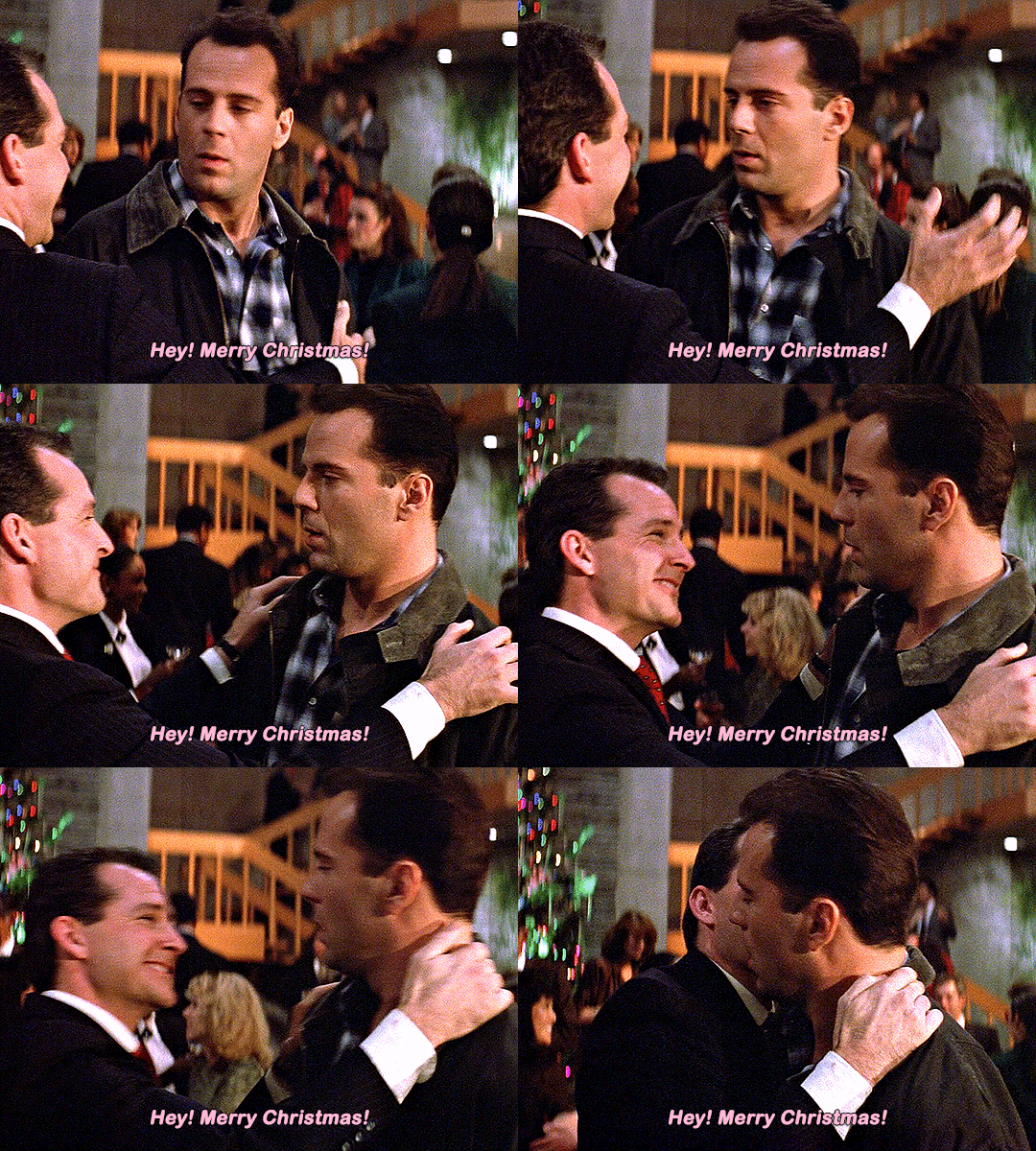
"DIE HARD" told the story of off-duty NYPD detective John McClane, who arrived in Los Angeles to reconcile with his estranged wife, Holly Gennero McClane. Husband and wife had clashed several months earlier when she accepted a job promotion with the Nakatomi Corporation that sent her to Los Angeles. A hired limousine driver named Argyle drives McClane to the Nakatomi Plaza building in Century City for the company's Christmas party. While, the detective changes clothes, the party is disrupted by the arrival of terrorist Hans Gruber and his armed followers. The latter seize control of the tower and the partygoers as hostages. Only McClane, armed with a pistol, manages to evade capture. Gruber's intentions are revealed, when he interrogates Nakatomi executive Joseph Takagi for the code to the building's vault that holds $640 million in bearer bonds. When Takagi refuses to cooperate, Gruber executes him. McClane manages to kill one of Gruber's men, taking the latter's weapon and radio. He uses the radio to contact the Los Angeles Police Department during a gunfight with more of Gruber's men on the roof. The L.A.P.D. eventually sends patrolman Sergeant Al Powell to investigate. When McClane drops one of Gruber's dead associates on Powell's patrol car roof, the latter finally summons the police force to respond. The incident also draws the attention of an ambitious local news reporter named Richard Thornburg, who is determined to learn McClane's identity. Despite the arrival of Deputy Chief Dwayne Robinson, numerous men that include a S.W.A.T. team, and later the F.B.I., McClane and Holly eventually realizes that matters have grown worse for both of them.

Most moviegoers and critics view "DIE HARD" as the best in the franchise. Is it the best? Hmmm . . . I really cannot say. As much as I love the movie, I certainly do not consider it perfect. The movie possesses flaws that I had not noticed during previous viewings and one particular flaw that I have noticed since I first saw it years ago. One aspect about "DIE HARD" that I found particularly annoying was the movie's pacing. Director John McTiernan did a pretty good job with the movie's pacing. Unfortunately, two-thirds into the movie, McTiernan began to lose steam and the pacing began to drag. Trimming the story would not have helped. I had no problem with the narrative during this film's period. But I did have a problem with the director's pacing. One of Roger Ebert's complaints about "DIE HARD" was its unflattering portrayal of the Los Angeles Police Department. And if I must be brutally honest, I share his complaint. I am not a great admirer of the L.A.P.D. or any police force. But the police's incompetency portrayed in the movie struck me as damn near unrealistic. I feel that McTiernan and screenwriters Steven E. de Souza and Jeb Stuart went a bit to the extreme to make John McClane look good. And if I must be brutally frank, the movie does feature some rather cheesy dialogue - especially from the villains. However, my biggest complaint regarding "DIE HARD" - the one flaw I have been aware of since I first saw the film - occurred in the final action scene. Back in the 1980s, it was popular in action or thriller movies to temporarily "resurrect" a villain/villainess before killing him or her for good. This happened with Glenn Close's character in the 1987 movie, "FATAL ATTRACTION". This also happened with Alexander Godunov's character in "DIE HARD". And you know what? I hate this kind of showy action. I found it stupid and cringe-worthy when I first saw the movie. And I still find it a major blot on this otherwise first-rate movie.

Flaws or no flaws, "DIE HARD" is without a doubt, a first-rate action thriller that helped defined the genre during the 1980s. While reading the plot for Roderick Thorp's 1978 novel, I was surprised to discover how much it resembled the 1988 film. There were some changes made in the latter. The main hero acquired a new name and shed at least two decades in age. Instead of a daughter, McClane's wife ended up as one of the hostages. The franchise's producers used the daughter character in the fourth film, "LIVE FREE OR DIE HARD". The German terrorist - renamed Hans Gruber - was more interested in pulling a heist than making a political statement. The Al Powell character is at least fifteen years older. And unlike Thorp's novel, "DIE HARD" ended on a more optimistic note for the two main characters.

Producers Lawrence Gordon and Joel Silver were lucky to gather such a talented cast and director for this movie. Thanks to the actors and director John McTiernan, "DIE HARD" featured some excellent dramatic moments. My favorite dramatic scenes include the tense quarrel between John and Holly before Gruber's arrival at the Christmas party, Gruber's interrogation of Joseph Takagi for the codes to the executive vault, Holly's tense interactions with Gruber, Takagi employee Harry Ellis' attempt to convince McClane to surrender to Gruber, McClane's accidental encounter with Gruber, and the many radio conversations between McClane and Powell. I found the latter especially impressive, considering that Bruce Willis and Reginald VelJohnson spent most of the movie apart.

But "DIE HARD" is, above all, an action film. And thanks to some members of the cast, a group of talented stuntmen and crew, the action sequences featured in the movie proved to be very memorable. If I had to choose those scenes that really impressed me, they would have to be the ones that featured Al Powell's awareness of the presence of terrorists at the Nakatomi Tower thanks to some gunfire and a dead body that landed on his patrol car, the S.W.A.T. team's failed assault on the building, and McClane's retaliation against the terrorists' massacre of the S.W.A.T. team (using explosives strapped to a chair). I was also impressed by the brief, yet final confrontation between the McClanes and Gruber. But for me, the most spectacular sequence turned out to be the rooftop explosion that claimed the lives of more Gruber men and two F.B.I. agents hovering above in an helicopter. Well-known cinematographer Jan de Bont and the special effects team really outdid themselves in that particular sequence.

As I had earlier pointed out, "DIE HARD" featured some outstanding performances. Bruce Willis was already a television star thanks to the 1980s series, "MOONLIGHTING". But his superb, yet tough performance as the besieged N.Y.P.D. detective John McClane not only made him an action star, but also a bona fide movie star. I believe that Holly Gennero McClane proved to be one of Bonnie Bedelia's best roles, thanks to her excellent performance as McClane's passionate and no-nonsense wife. "DIE HARD" also made a star of Alan Rickman, thanks to his deliciously sardonic performance as the ruthless Hans Gruber. In fact, his Gruber happens to be one of my favorite cinematic villains of all time. Reginald VelJohnson's career also benefited from his first-rate performance as the compassionate L.A.P.D. officer, Sergeant Al Powell.

There were other performances in "DIE HARD" that caught my attention. Ballet dancer Alexander Godunov gave a very competent performance as Gruber's right-hand man, Hans, who wants revenge for McClane's killing of his younger brother. Hart Bochner was very entertaining as Holly's gauche co-worker, Harry Ellis. However, I must admit that I found the character somewhat one-dimensional. William Atherton was very memorable as the ambitious and slimy news reporter, Richard Thornburg. Clarence Gilyard revealed a talent for comic acting, in his excellent portrayal of Gruber's sardonic and cold-blooded computer specialist, Theo. Andreas Wisniewski was excellent as Hans' younger brother, the no-nonsense Karl. Robert Davi and Grand L. Bush (who reunited in the 1989 James Bond movie, "LICENSE TO KILL") made a great screen team as the arrogant F.B.I. Special Agents Johnson and Johnson. De'voreaux White, someone I have not seen in years, provided his own brand of sharp humor and the movie's best line as McClane's limousine driver, Argyle. And finally, the late Paul Gleason proved to be very entertaining as the not-so-bright Deputy Police Chief Dwayne Robinson.

I find myself back at that moment in which I pondered over the reputation of "DIE HARD". Do I still believe it is one of the best action movies ever made? Perhaps. Perhaps not. I have seen my share of action movies that strike me as equally good - including other films in the DIE HARD franchise. And the movie does have its share of flaws. But "DIE HARD" is also a personal favorite of mine, thanks to John McTiernan's excellent direction, a first-rate adaptation of Roderick Thorp's novel, superb action-sequences and outstanding performances from a stellar cast led by Bruce Willis. Over twenty-five years have passed since the movie's initial release. And honestly . . . it has not lost one bit of its magic.


1174577_300

Fox Plaza Tower aka the Nakatomi Tower in Century City, CA


"LOST": The Death of Nathan

  (2.07) ”The Other 48 Hours”  is the 31st episode of  ”LOST”  that aired on November 16, 2005. This episode featured the Tail Section passe...