Saturday, May 6, 2023

"'FLASHFORWARD': A Potential Nipped in the Bud"


"'FLASHFORWARD': A POTENTIAL NIPPED IN THE BUD"

Ever since ABC had cancelled one of its freshman series from the 2009-2010 television season, the science-fiction drama called "FLASHFORWARD", many television critics and fans have expressed the belief that the series had failed to garner enough viewers due to its less than stellar writing. Now . . . I have stated that although many have expressed this belief, but there were a good number of viewers who believe that the network should have given the series a chance to grow over the years. I happen to be one of those who agree with the latter.

Based upon the 1999 novel written by Robert J. Sawyer, "FLASHFORWARD" revolved around the lives of several people after a mysterious event caused nearly everyone on the planet to simultaneously lose consciousness for two minutes and seventeen seconds on October 6, 2009. During this "blackout” people saw what appeared to be visions of their lives on April 29, 2010 - a global "flashforward". Created by Brannon Braga and David S. Goyer, the series starred Joseph Fiennes, John Cho, Courtney B. Vance, Christine Woods, Jack Davenport, Sonia Walger and Dominic Monaghan.

When the series had first aired in late September 2009, it became an immediate ratings hit and stayed that way during its first ten (10) episodes. Then ABC made the decision to put the series on hiatus for three-and-a-half months. Why? I have no idea. But after the series resumed its run in mid-March 2010, its ratings tanked. In fact, the ratings remained low until it was finally cancelled by ABC some two-and-a-half months later. Does this story sound familiar? Why, yes it does. The very same fate nearly befell the CBS science-fiction/post-apocalypse series, ”JERICHO”. Thanks to a campaign by fans to save the series, ”JERICHO” was given a second season – which amounted to eight episodes that aired in a new time slot that guaranteed its rating failure - namely Tuesday nights at 10:00 PM. A similar thing happened to NBC's "TIMELESS", which was moved to Sunday nights at 10:00 PM. And both shows have become cult favorites. But no amount of fan campaign could convince ABC to give "FLASHFORWARD" a second chance. Even though there were a good number of fans who became angry at how the network handled the series, it never became a cult favorite like "JERICHO" and "TIMELESS".

Yet, those critics and fans who did not criticize ABC’s handling of the series claimed that "FLASHFORWARD" was an immediate failure that destined for cancellation. Many of these critics and viewers claimed that the series failed to live up to the same quality as the pop culture classic, "LOST". To this day, I still have a problem with this assessment of "FLASHFORWARD". One, its only season had just begun, when this assessment was made against it. To expect the series to be perfect right off the bat had struck me as ridiculous. Now, I realize that both "LOST" and the NBC series, "HEROES", managed to immediately dazzle U.S. viewers and critics with highly regarded series premieres and well written first seasons. "LOST" managed to toe the line and become what I believe to be one of the best television series ever. But I feel that "HEROES" managed to do nothing but decline in quality in years, following its freshman season. "LOST" managed to maintain the momentum of its dazzling debut, despite a minor setback in quality during the first half of its third season. As for "HEROES", I thought its writing simply went down the drain following its first season. How it managed to stay on the air for another three seasons amazes me to this day.

Ever since the dazzling debuts of "LOST" and "HEROES"; television network executives have expected and demanded that other multi-seasonal series with a science-fiction/fantasy background repeat their initial success. I believe that this was a mistake. Some of the best science-fiction/fantasy television series I have seen have started out with a less than dazzling or even mediocre season debut. Good examples of this are “BABYLON 5″“JERICHO” and “BUFFY THE VAMPIRE SLAYER”. Both ”BABYLON 5” and ”BUFFY THE VAMPIRE SLAYER” were given chances to fulfill their potential. Just as "JERICHO" was developing into a well-written series, CBS permanently pulled its plug . . . aborting its chances of fulfilling any potential.

As I had stated earlier, "FLASHFORWARD" also started with a less than dazzling first season. I might as well be frank. It was not perfect. But I do believe that it had great potential to grow into a well written saga. If the series had first aired over two decades ago, I suspect that it may have been given the chance to develop into something remarkable. I believe it certainly had that potential. Unfortunately, we viewers are still mired in the "LOST"/"HEROES" era of television broadcasting in which certain shows are expected to dazzle viewers in the pilot episodes.

Today’s television network executives, critics and viewers seemed to lack the patience or willingness to give a series a chance to grow. They want and demand instant success. In fact, I am beginning to suspect that many are becoming less tolerant of the television serial format. Unless these executives, critics and viewers are willing to change their modis operandi; future serial science-fiction/fantasy television series with levels of qualities similar to "BABYLON 5""BUFFY THE VAMPIRE SLAYER""LOST" and "JERICHO" threaten to become a thing of the past. I certainly did not see that level of quality writing in shows like "HEROES", despite its longevity on the air.


Monday, April 24, 2023

"OTHER MEN'S WOMEN" (1931) Review


"OTHER MEN'S WOMEN" (1931) Review

Adultery is rarely treated with any kind of maturity in fiction - whether in novels, plays, movies and television. I am not saying that adultery has never been portrayed with any maturity. It is just that . . . well, to be honest . . . I have rarely come across a movie, television series, novel or play that dealt with adultery in a mature manner. Or perhaps I have rarely come across others willing to face fictional adultery between two decent people with some kind of maturity.

If one simply glanced at the title of the 1931 movie, "OTHER MEN'S WOMEN", any person could assume that he or she will be facing one of those salacious tales from a Pre-Code filled with racy dialogue, scenes of women and men stripping to their underwear or morally bankrupt characters. Well, "OTHER MEN'S WOMEN" is a Pre-Code movie. But if you are expecting scenes and characters hinting sexy and outrageous sex, you are barking up the wrong tree.

"OTHER MEN'S WOMEN" is about a young railroad engineer named Bill White, who seemed to have a drinking problem. When he gets kicked out of his boarding house, after falling back on his rent, Bill is invited by fellow engineer and friend Jack Kulper to stay with him and his wife Lily. All seemed to be going well. Bill managed to fit easily into the Kulper household. He stopped drinking. And he got along very well with both Jack and Lily. In reality, his relationship with Lily seemed to be a lot more obvious than with Jack. And this spilled out one afternoon, when in the middle of one of their horseplays while Jack was out of the house, Bill and Lily exchanged a passionate kiss. Realizing that he was in love with Lily, Bill moved out and left Jack wondering what had occurred. Matters grew worse and eventually tragic, when Jack finally realized that Bill and Lily had fallen in love with each other.

From the few articles I have read, there seemed to be a low regard for this film. Leading lady Mary Astor had dismissed it as "a piece of cheese" and praised only future stars James Cagney and Joan Blondell. Come to think of it, so did a good number of other movie fans. Back in 1931, the New York Times had described the film as "an unimportant little drama of the railroad yards". Perhaps "OTHER MEN'S WOMEN" was unimportant in compare to many other films that were released in 1931 or during that period. But I enjoyed it . . . more than I thought I would.

"OTHER MEN'S WOMEN" is not perfect. First of all, this is an early talkie. Although released in 1931, the film was originally shot and released to a limited number of theaters in 1930. And anyone can pretty much tell this is an early talkie, due to the occasional fuzzy photography. Also, director William Wellman shot a few of the action scenes - namely the fight scene between Bill and Jack, along with Bill and another engineer named Eddie Bailey - in fast motion. Or he shot the scenes and someone sped up the action during the editing process. Why, I have no idea. There were a few times when members of the cast indulge in some theatrical acting. And I mean everyone. Finally, I found the resolution to the love triangle in this film a bit disappointing. Considering that divorce was not as verboten in the early 20th century, as many seemed to assume, I do not see why that the whole matter between Bill, Lily and Jack could have been resolved with divorce, instead of tragedy. In the case of this particular story, I found the tragic aspects a bit contrived.

Otherwise, I rather enjoyed "OTHER MEN'S WOMEN", much to my surprise. Repeating my earlier statement, I was impressed by how screenwriter Maud Fulton, with the addition of William K. Wells' dialogue; treated the adulterous aspects of the love triangle with taste and maturity. What I found even more impressive is that the three people involved were all likeable and sympathetic. I was rather surprised that this film only lasted 70 minutes. Because Wellman did an exceptional job with the movie's pacing. He managed to infuse a good deal of energy into this story, even when it threatened to become a bit too maudlin.

Wellman's energy seemed to manifest in the cast's performance. Yes, I am well aware of my complaint about the performers' occasional penchant for theatrical acting. But overall, I thought they did a very good job. Future stars James Cagney and Joan Blondell had small supporting roles as Bill's other friend Eddie Bailey and his girlfriend, Marie. Both did a good job and both had the opportunities to express those traits that eventually made them stars within a year or two. I was especially entertained by Blondell's performance, for she had the opportunity to convey one of the movie's best lines:

Marie: [taking out her compact and powdering her face] Listen, baby, I'm A.P.O.

Railroad worker at Lunch Counter: [to the other railroad worker] What does she mean, A.P.O.?

Marie: Ain't Puttin' Out!


I noticed that due to Cagney and Blondell's presence in this film, many tend to dismiss the leading actors' performances. In fact, many seemed to forget that not only was Mary Astor a star already, she was a decade away from winning an Oscar. Well, star or not, I was impressed by her portrayal of the railroad wife who finds herself falling in love with a man other than her own husband. She gave a warm, charming and energetic performance. And she portrayed her character's guilt with great skill. I could also say the same about leading man, Grant Withers. He is basically known as Loretta Young's first husband. Which is a shame, because he seemed like a first-rate actor, capable of handling the many emotional aspects of his character. Whether Bill was drunk and careless, fun-loving, romantic or even wracked with guilt, Withers ably portrayed Bill's emotional journey. I also enjoyed Regis Toomey's performance as the emotionally cuckolded husband, Jack Kulper. I mainly remember Toomey from the 1955 musical, "GUYS AND DOLLS". However, I was impressed by how he portrayed Jack's torn psyche regarding his best friend and wife.

I am not going to pretend that "OTHER MEN'S WOMEN" is one of the best films from the Pre-Code era . . . or one of director William Wellman's best films. Perhaps that New York Times critic had been right, when he described the film as "an unimportant little drama of the railroad yards". But I cannot dismiss "OTHER MEN'S WOMEN" as a mediocre or poor film. It is actually pretty decent. And more importantly, thanks to the screenplay, Wellman's direction and the cast, I thought it portrayed a love triangle tainted by adultery with a great deal of maturity.


Thursday, April 13, 2023

"SUNSET" (1988) Photo Gallery

 kinopoisk.ru-Sunset-1350996


Below are images from the 1988 movie, "SUNSET". Directed by Blake Edwards and based on Rod Amateau's novel, the movie starred James Garner and Bruce Willis:


"SUNSET" (1988) Photo Gallery

susnet


kinopoisk.ru-Sunset-1350993


MV5BMTM5NTc5MjQwMl5BMl5BanBnXkFtZTcwODk0MjMyNA@@._V1._SX640_SY537_


kinopoisk.ru-Sunset-1804301


kinopoisk.ru-Sunset-1804305


kinopoisk.ru-Sunset-1804306


kinopoisk.ru-Sunset-1804307


kinopoisk.ru-Sunset-1804308


kinopoisk.ru-Sunset-1804309


kinopoisk.ru-Sunset-1804310


kinopoisk.ru-Sunset-1528597


kinopoisk.ru-Sunset-1528598


kinopoisk.ru-Sunset-1528599


kinopoisk.ru-Sunset-1528600


kinopoisk.ru-Sunset-1804299


kinopoisk.ru-Sunset-1804300

Friday, March 31, 2023

Kathryn Janeway and Starfleet Principles - “STAR TREK VOYAGER” (2.14) "Alliances"


KATHRYN JANEWAY AND STARFLEET PRINCIPLES - "STAR TREK VOYAGER" (2.14) "Alliances"

Many ”STAR TREK” fans have claimed that the lead character of ”STAR TREK VOYAGER” lead character, Captain Kathryn Janeway, barely developed as a character during the series’ seven (7) season run. After watching the Season Two episode, (2.14) "Alliances”, I am can see that I would never agree with those critics of Janeway’s character. The Season Two Kathryn Janeway featured in this episode struck me as a far cry from the Kathryn Janeway that finally returned to Earth in the series finale, (7.25-7.26) “Endgame”.

But this article is not simply about Kathryn Janeway. It is mainly about the good captain and the major role she played in ”Alliances”. The episode began with a Kazon attack upon Voyager, which resulted in damages to the starship, several wounded and the death of another Voyager crewman - the popular ex-Maquis and close friend of Commander Chakotay named Kurt Bendera. After Chakotay delivered the eulogy after the funeral, Crewmen Hogan and Michael Jonas voiced their opinion to Captain Janeway that Voyager should operate in a manner similar to the Maquis and consider making a deal with the Kazon for safe passage. Naturally, Janeway refused to consider the idea of trading technology with Kazon, which is something they have proposed in the past. But her resistance to the idea of an alliance eventually faded when Chakotay and Lieutenant Tuvok both proposed that she consider an alliance with one or two Kazon factions to secure peace. Not to trade technology, but to offer protection from attacking forces and emergency supplies. As I had pointed out, the Captain was reluctant to accept Chakotay’s idea, but eventually accepted. Ensign Harry Kim seemed horrified by the idea, claiming that the Federation would never consider forming alliances with the likes of the Kazon. Apparently, the young ensign forgot about the treaty that the Federation had signed with the Klingon Empire in the late 23rd century (something that Tuvok had reminded the Captain about) and one with Cardassia just a few years earlier. Fortunately, Janeway ignored Kim’s protests.

During the series’ first two seasons, Janeway had been a rigid practitioner of Starfleet's principles, unwilling to be flexible about her command style. She also had a bad habit of ignoring advice that required her to be a little more flexible . . . unless it suited her. Obviously, Chakotay's suggestion of mixing a little Starfleet principle with Maquis methods never really appealed to Janeway. And I got the feeling that she was determined to prove him wrong. Bear with me. There was nothing wrong in Janeway’s policies about following Starfleet principles - when the situation demanded it. After all, if Janeway had not maintained discipline on her ship, Voyager could have easily become another U.S.S. Equinox. However, there was a time for adhering to Starfleet . . . and a time for using other methods.

Chakotay's idea of forming an alliance with the Kazon seemed sound. Even Tuvok thought it was a good idea. Yet, Janeway decided to sabotage Chakotay’s idea by accepting Torres and Paris’ not-so-bright suggestion of forming an alliance with Seska and Maj Cullah of the Kazon Nistrim sect. Why on earth would she agree to sign a treaty with the very Kazon sect that the crew of Voyager had been in conflict with since Season One’s (1.11) “State of Flux”? And why did she not simply consider contacting other Kazon sects, as Chakotay and Tuvok had suggested. Then Janeway added more fuel to the fire when she disregarded Tuvok's advice against forming an alliance with the Trabe, the Kazons' blood enemy. The Trabe used to be a major power in the Delta Quadrant and also brutal slave masters ruling over the Kazon race. The Kazon eventually revolted and stole all of the Trabe technology, spacecraft and even their home world. The Trabe had been reduced to wanderers that were constantly pursued by Kazon fleets and unable to settle on any permanent planet for fear of being exterminated by the former slaves. In the end, Tuvok’s objections against an alliance with the Trabe proved to be sound. The effort to form an alliance with the Kazon ended up being undermined by the Trabe’s attempt to assassinate the Kazon majes (leaders).

As I had earlier stated, one of Janeway's major flaws had been her inability to be flexible in the face of Voyager’s extraordinary situation in the Delta Quadrant. During Seasons One and Two, she seemed obsessed with maintaining Starfleet principles. In the end, this strict adherence to these principles did not prevent Voyager's capture by Seska, Maje Cullah and the Kazon in the Season Two finale, (2.26) “Basics, Part I”. Following this last incident with Seska and the Kazon, Janeway switched tactics and adhered more closely with utilizing Maquis methods. I would have cheered her for this . . . except she went from one extreme to another. Her determination to use any means possible to get home nearly led to Voyager's destruction in the early Season Three episode, (3.04)"The Swarm”, when she decided to trespass into a hostile alien space after being warned away. Another form of this kind of extremism occurred when she decided to form an alliance with the Borg in order to avoid what she believed was certain destruction at the hands of Species 8472 in (3.26-4.01) “Scorpion”. This alliance led to Species 8472’s defeat and many home worlds opened to conquest and assimilation by the Borg. After Voyager's encounter with the U.S.S. Equinox in (5.26-6.01) “Equinox”, Janeway finally learned to become flexible by striking a balance between maintaining Starfleet principles and being a little creative when the occasion demanded.

As for "Alliances", it had the potential to be an excellent episode. Unfortunately, too much had occurred during the episode’s 45-50 minutes running time. ”Alliances” could have . . . should have been a two-part episode. But writer/producer Jeri Taylor decided to stuff this very eventful story into one episode. Worse, the story ended on a sour note with Janeway's speech reaffirming Starfleet principles. Her strident speech not only made me wince, it also made me wonder if she was feeling a little smug at proving both Chakotay and Tuvok wrong. The ending did not strike me as one of her finest hours.


Friday, March 17, 2023

"COWBOYS & ALIENS" (2011) Review


"COWBOYS & ALIENS" (2011) Review

Ever since its release during the summer of 2011, many have been contemplating on the box office failure of "COWBOYS & ALIENS". I could go over the many theories spouted about its failure over the years, but I would find that boring. I am simply aware that the movie had only earned $34 million dollars short of its budget. And all I can say is . . . what a damn pity.

"COWBOYS & ALIENS" had some big names participating in its production. Daniel Craig and Harrison Ford were the movie's stars. The cast also included well known names such as Sam Rockwell, Adam Beach, Keith Carradine, Paul Dano and Clancy Brown. Jon Farveau, the director of the two successful "IRON MAN" movies, helmed the director's chair. At least five of the screenwriters - Damon Lindelof, Alex Kurtzman, Roberto Orci, Mark Fergus, and Hawk Ostby - have been associated with projects like "LOST" and the "STAR TREK". And big names in the film industry such as Ron Howard, Brian Grazer and Steven Spielberg acted as some of the producers. But despite all of this "COWBOYS AND ALIENS" remained one of the flops of this summer. Again, pity. I realize that I keep using the word "pity" as a response to the movie's failure. But I cannot help it. I really enjoyed "COWBOYS AND ALIENS". In fact, I enjoyed it so much that it has become one of my favorite movies from the summer of 2011.

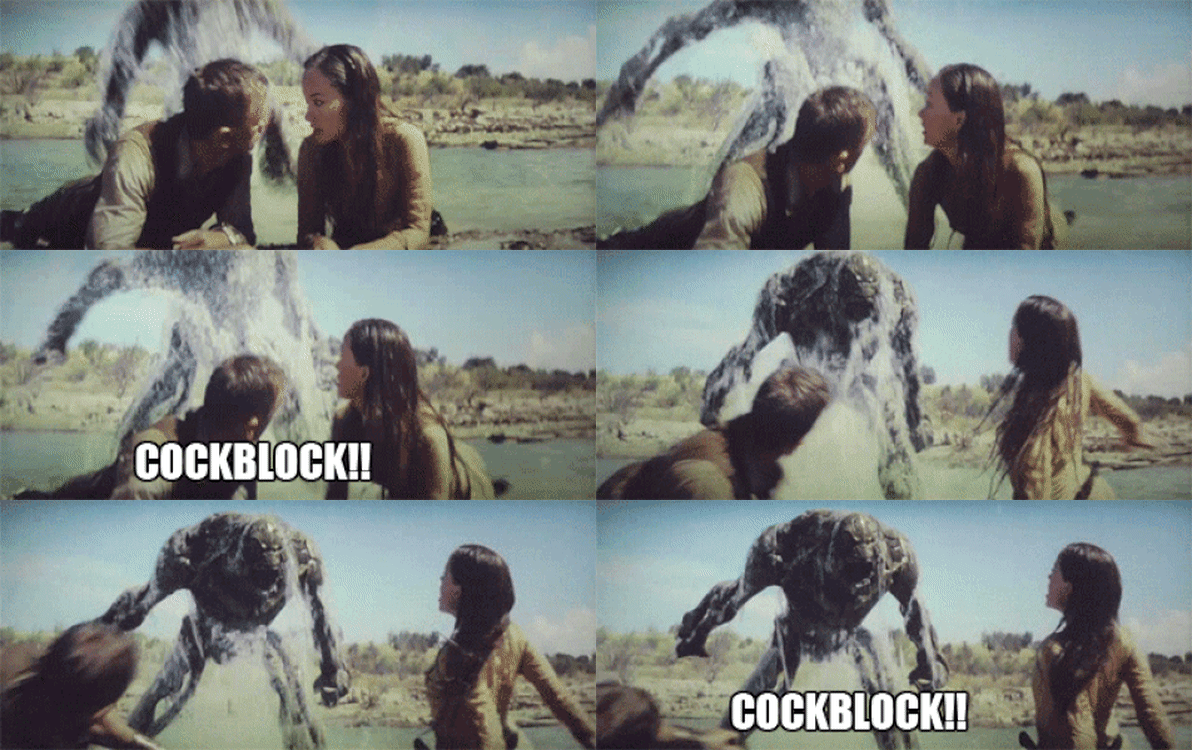
The movie was based upon the 2006 graphic novel by Scott Mitchell Rosenberg. It told the story of an alien invasion that occurred in the New Mexico Territory in 1873. The story focused upon a mysterious loner that awakens in the desert, injured and wearing a strange bracelet shackled to his wrist. He wanders into the town of Absolution, where the local preacher, Meacham treats his wound. After the stranger subdues Percy Dolarhyde, who has been terrorizing the populace, Sheriff Taggart recognizes the loner as Jake Lonergan, a wanted outlaw, and tries to arrest him. Jake nearly escapes, but a mysterious woman named Ella Swenson knocks him out. Percy's father, Colonel Woodrow Dolarhyde, a rich and influential cattleman, arrives with his men and demands that Percy be released to him. He also wants Jake, who had stolen Dolarhyde's gold. During the standoff, alien spaceships begin attacking the town. Percy, Sheriff Taggart and many townsfolk are abducted. Jake shoots down one ship with a device concealed in his wrist band, ending the attack. Realizing that the bracelet that Jake wears stands between them and the aliens, Colonel Dolarhyde, Meacham and Ella convinces Jake to help them find the aliens and the kidnapped townspeople, despite the fact that he has no memory of his own identity, let alone of any previous encounters with the aliens. Their expedition leads them Jake's former gang and a band of Chiricahua Apaches, who have also been victims of the aliens.

"COWBOYS & ALIENS" is not perfect. It has its flaws. To be honest, I can think of one or two flaws. Perhaps one. Although I understood that the aliens were taking the gold found near Absolution to power their starship, the script never made it clear on why they were taking the populace, as well. The only thing that the script made clear was that the kidnapped populace were being experimented upon. When it comes to human experimentation of reasons behind an invasions, many plots for alien invasion movies and television series tend to be rather weak in this area, including some of the best in this genre. And my other problem was that the script failed to reveal how Ella, who turned out to be another alien whose people had been destroyed by the invaders, ended up on Earth.

But despite these flaws, "COWBOYS & ALIENS" really impressed me. I thought that Jon Favreau did an excellent job in combining action with the film's dramatic moments. And his eye for location, greatly assisted by Matthew Libatique's photography of the New Mexican countryside, gave the movie's visuals a natural grandeur. In my review of "SUPER 8", I had commented that it reminded me of an old "STAR TREK VOYAGER" episode. I cannot say the same for "COWBOYS & ALIENS". But it did remind me of a "STAR TREK VOYAGER" fanfiction story called "Ashes to Ashes". At least Jake's experiences with the aliens before the movie began. And "COWBOYS & ALIENS" must be the only alien invasion movie I can think of that was set before the 20th century. It occurred to me that if the two most famous adaptations of H.G. Wells' novel, "War of the Worlds" had been given its original setting, this would not have been the case. Unless someone knows of another alien invasion movie with a pre-20th century setting. Ever since I first saw the trailers for "COWBOYS & ALIENS", I wondered how the screenwriters would combine the two genres of Science-Fiction and Westerns. Hell, I wondered if they could. Mixing Jake's history as an outlaw with his experiences with the aliens did the trick. At least I believe so. More importantly, "COWBOYS & ALIENS" provided plenty of opportunities for character development - and that includes the supporting cast.

The cast certainly proved to be first-rate. There have been British actors who have appeared in Westerns before. Come to think of it, Daniel Craig is not even the first James Bond actor who has appeared in a Western. But he is the only one I can recall who appeared in a Western as an American-born character. And if I must be blunt, the man takes to Westerns like a duck to water. More importantly, both Craig's super performance and the screenwriters made certain that his Jake Lonergran did not come off as some cliché of the "Man With No Name" character from Sergio Leone's DOLLAR TRILOGY". Craig made him a man determined to learn of his past, while dealing with the sketchy memories of a past love and his attraction toward Ella.

The character of Colonel Woodrow Dolarhyde seems like a far cry from Harrison Ford's usual roles. His Colonel Dolarhyde was not the solid Jack Ryan type or the rough, yet dashing Indiana Jones persona. In one of his rare, offbeat roles, Ford's Colonel Dolarhyde was a ruthless, no-nonsense man who ruled his ranch and the town of Absolution with an iron fist. And Ford did a first-rate job of diluting Dolarhyde's distasteful ruthlessness into something more . . . human and warm. I wondered how I would take Olivia Wilde's performance as the mysterious Ella Swenson, who seemed determined to get Jake to help the rest of Absolution's citizens find the aliens. After seeing the movie, I enjoyed her performance very much. She had a strong chemistry with Craig. More importantly, she gave a solid performance and possessed a strong screen presence. But I really enjoyed about Wilde's performance was that she conveyed an other world quality about Ella that strongly hinted her role as an alien who landed on Earth to find the invaders who had destroyed most of her race.

The supporting cast was led by the likes of Sam Rockwell, who competently portrayed Absolution's insecure saloon keeper, Doc; and Adam Beach, who gave a deliciously complex performance as Dolarhyde's right-hand man, Nat Colorado. And actors such as Paul Dano as Dolarhyde's s raucous son, a serene Clancy Brown, Noah Ringer (from "THE LAST AIRBENDER"), who portrayed the sheriff's grandson, and a solid Keith Carradine gave firm support.

I do not know what else I could say about "COWBOYS & ALIENS". I find it a pity that it had failed to become a hit. Because I really enjoyed it. The screenwriters, along with cinematographer Matthew Libatique, a first-rate cast led by Daniel Craig and Harrison Ford and fine direction by Jon Favreau made it one of my favorite films from the summer of 2011.


Tuesday, March 14, 2023

"LIONS FOR LAMBS" (2007) Photo Gallery


Below are images from "LIONS FOR LAMBS", the 2007 political drama directed by and starring Robert Redford. Tom Cruise and Meryl Streep co-starred.


"LIONS FOR LAMBS" (2007) Photo Gallery


Monday, March 6, 2023

"FLASHMAN" (1969) Book Review


"FLASHMAN" (1969) Book Review

Fifty-four years ago, an old literary character was re-introduced to many readers, thanks to a former Scottish journalist named George MacDonald Fraser. The author took a character from a famous Victorian novel and created a series of novels that placed said character in a series of historical events throughout the middle and second half of the 19th century.

The 1857 novel, ”TOM BROWN’S SCHOOLDAYS”, told the story of a young English boy named Tom Brown and his experiences at the famous school, Rugby, during the 1830s. One of Tom’s travails focused on his abuse at the hands of an older student – a bully – named Flashman. However, Flashman got drunk at a local tavern and in the following morning was expelled by Rugby’s famous headmaster, Dr. Thomas Arnold. Fraser took the Flashman character, gave him a first name – Harry – and continued his story following the expulsion from Rugby in the 1969 novel, "FLASHMAN".

The beginning of the novel saw the seventeen-year-old Harry Flashman trying to find a new profession following his expulsion from Rugby. Due to his father’s wealth and his maternal Uncle Bindley Paget’s social connections, Flashman found a position as a junior officer in one of Britain’s most elite Army regiments, the 11th Hussars aka the Cherrypickers. And thanks to his talent for toadying and projecting a sense of style (inherited from his aristocratic late mother), Flashman managed to win the support and favor of the regimental commander, the haughty James Thomas Brudenell, 7th Earl of Cardigan. Unfortunately, Flashman’s ideal life as a leisurely Army officer came to an end. His involvement with the French mistress of a fellow officer kicked off a series of events that led to Flashman being swept into the First Anglo-Afghan War (1839-1842). One of those events included seducing one Elspeth Morrison, the sixteen-year-old daughter of a wealthy Scottish merchant. After being forced to marry her by her relations, Flashman was kicked out of the 11th Hussars and sent to India by Lord Cardigan, who regarded the marriage as a step down the social ladder for the usually favored young Army officer.

It was in Afghanistan that Flashman earned the nickname, “Bloody Lance” by taking credit for his servant’s killing of four Afghan attackers. There, he also met one Ilderim Khan, the son of a pro-British Afghan nobleman and became the latter’s lifelong friend and blood brother. This friendship would end up saving Flashman’s life during the Sepoy Rebellion in ”FLASHMAN IN THE GREAT GAME”. Flashman also managed to earn two deadly enemies – an Afghan warlord named Gul Shah and his mistress (later wife), a dancer named Narreeman. The source of the pair’s enmity toward Flashman originated with his rape of Narreeman.

More importantly, ”FLASHMAN” allowed readers to view many important events of the First Anglo-Afghan War. Not only did Flashman meet many historical figures such as Lord Cardigan, Queen Victoria, Prince Albert, the Duke of Wellington, but also Alexander Burnes, Akbar Khan, William Macnaghten, Thomas Arnold, and the incompetent commander of the British Army in Afghanistan, General William Elphinstone.

I must admit that my opinion of the novel has changed a great deal over the years. Originally, I held a low opinion of ”FLASHMAN” for years, comparing it to the more epic-like sagas such as ”FLASHMAN AT THE CHARGE” (1973)”FLASHMAN IN THE GREAT GAME” (1975)”FLASHMAN AND THE REDSKINS” (1982) and ”FLASHMAN AND THE DRAGON” (1985). I still regard these four novels in a higher regard than ”FLASHMAN”. But I must admit that perhaps I had been a little unfair in my regard for the 1969 novel. It is actually a solid adventure story filled with historical interest, witty humor, sharp action and excellent pacing. Some fans of The Flashman Papers have expressed disgust or disenchantment with the Harry Flashman character portrayed in this novel. I suspect that a great deal of these negative opinions may have stemmed from Flashman’s rape of Narreeman. And I understand. However, many of these fans also complained about the young British officer’s crass style and manner – especially toward his father’s mistress, Judy. One has to remember that Harry Flashman aged from 17 to 20 years old in this story. He did convey some semblance of the style, common sense and instinct that would fool many people and serve him for years. But as an adolescent on the threshold of twenty, he had yet to learn some of the hard facts of life. As for his rough treatment and negative opinion of Judy, I suspect that his ego suffered a massive blow, when she rejected him, following a one-time bout under the sheets. A blow that he obviously had failed to recover from after six decades, while writing "his memoirs".

”FLASHMAN” also had its share of interesting fictional characters. I have already mentioned the villainous Gul Shah and his mistress (later wife) Narreeman. I have also mentioned the young Afghan who became a close friend of Flashy’s, Ilderim Khan. But he had an even larger role in ”FLASHMAN IN THE GREAT GAME”. And as I had mentioned, Elspeth also appeared in the novel. However, her presence in the novel would not be truly felt, until the last chapter that featured Harry’s homecoming. Fraser barely explored her personality in the novel, but he did allow a peek into her promiscuous and self-absorbed nature in that last chapter. One particular character, Sergeant Hudson, proved to be a reliable source of defense for Flashman during the retreat from Kabul. During this event, Flashman experienced one of the most bizarre moments of his life, while being rejected by the young wife of an Army officer named Mrs. Betty Parker, whom he was trying to seduce:

"'What the devil' says I. 'What’s the matter?'

'Oh, you brute!' she hissed - for she had the sense to keep her voice down – 'you filthy, beastly brute! Get out of my tent at once! At once, d’you her?'

I could make nothing of this and said so. 'What have I done? I was only being friendly. What are you acting so damned missish for?'

'Oh base!' says she. 'You . . . you . . .'

'Oh, come now,' says I. 'You’re in very high ropes, to be sure. You weren’t so proper when I squeezed you the other night.'

'Squeezed me?' says she, as though I had uttered some unmentionable word.

'Aye, squeezed. Like this.' And I reached over and, with a quick fumble in the dark, caught one of her breasts. To my amazement, she didn’t seem to mind.

'Oh, that!' she says. 'What an evil creature you are! You know that is nothing; all gentlemen do that, in affection. But you, you monstrous beast, presume on my friendship to try to . . . Oh, oh, I could die of shame!'

If I had not heard her, I shouldn’t have believed it. God knows I have learned enough since of the inadequacies of education given to young Englishwomen, but this was incredible."


This last encounter with Mrs. Betty Parker struck me as a hilarious metaphor for the blindingly naïve morality that had begun to encroach early Victorian society.

”FLASHMAN” also provided some interesting historical vignettes from the First Anglo-Afghan War. And young Flashman managed to witness or participate in a good number of them. The novel allowed him to be the sole surviving British witness to the murder of political officer, Sir Alexander Burnes and his younger brother, Charles. He also witnessed the murder of another political officer named Sir William Macnaghten, along with Last Stand at Gandamak and the Siege of Jalalabad. But Fraser’s pièce de résistance in ”FLASHMAN” proved to be the disasterous Kabul retreat in which the British contingent under General Elphinstone were forced to march from Afghanistan to India in cold weather and dire circumstances:

"From other accounts of that frightful march that I have read – mostly Mackenzie’s and Lawrence’s and Lady Sale’s – I can fit a few of my recollections into their chronicle, but in the main it is just a terrible, bloody nightmare even now, more than sixty years after. Ice and blood and groans and death and despair, and the shrieks of dying men and women and the howling of the Ghazis and Gilzais. They rushed and struck, and rushed and struck again, mostly at the camp-followers, until it seemed there was a slashed brown body every yard of the way. The only place of safety was in the heart of Shelton’s main body, where the sepoys still kept some sort of order; I suggested to Elphy when we set off that I and my lancers should ride guard on the womenfolk, and he agreed at once. It was a wise move on my part, for the attacks on the flanks were now so frequent that the work we had been doing yesterday was become fatally dangerous. Mackenzie’s jezzailchis were cut to ribbons stemming the sorties."

Reading the above passage made me wonder about the wisdom of the current Western presence in Afghanistan. And there is nothing like a British military disaster to bring out the best of Fraser’s writing skulls. It proved to be the first of such passages in novels like ”FLASHMAN IN THE GREAT GAME” and ”FLASHMAN AND THE REDSKINS”.

In the end, Fraser did a solid job in initiating what would prove to be The Flashman Papers in his first novel, ”FLASHMAN”. Granted, the novel’s first part set in England struck me as slightly rushed. And the Harry Flashman character seemed a bit crude in compared to his characterizations in the novels that followed. Like many other readers, I found his rape of the Narreeman character hard to stomach. But Fraser did an excellent job in re-creating early Victorian Britain, British India, Afghanistan and the First Anglo-Afghan War. In short, ”FLASHMAN” turned out to be a solid start to an excellent series of historical novels.


"BAND OF ANGELS" (1957) Review

  "BAND OF ANGELS" (1957) Review I have been a fan of period dramas for a long time. A very long time. This is only natural, consi...