Showing posts with label religion. Show all posts

Sunday, January 25, 2026

"THE MEN WHO STARE AT GOATS" (2009) Review


"THE MEN WHO STARE AT GOATS" (2009) Review

Grant Heslov directed this comedic adaptation of Jon Ronson’s 2004 book about the U.S. Army's exploration of New Age concepts and the potential military applications of the paranormal. The movie starred George Clooney as one of the participants in this program and Ewan McGregor, who portrayed a journalist who stumbles across the story, while reporting on businesses with military contracts in Iraq.

One of the surprising aspects about "THE MEN WHO STARED AT GOATS" is that its story is based upon fact. According to author Jon Ronson, there was actually a similar unit actually existed within the U.S. Army called the Stargate Project. The film featured a different name for the units . . . and had probably changed some of the facts, but the Army did explore New Age concepts and military applications of the paranormal. "THE MEN WHO STARED AT GOATS" followed McGregor’s character, a journalist with the Ann Arbor Daily Telegram named Bob Wilton. After an emotional divorce from an unfaithful wife, Bob goes to Kuwait to report on the Iraq War. He stumbles upon an interesting story when he meets a Special Forces operator named Lyn Cassady during a trip across the Iraqi countryside. During the road trip, Cassady reveals his participation in an Army unit that trained to develop a range of par psychological skills by using New Age concepts. The unit ended up being named the New Earth Army. While the pair endured a journey that included encounters with a gang of Iraqi criminals, a kidnapped victim of the criminals, the head of a private security firm named Todd Nixon and two rival groups of American contractors who engage in a gunfight against each other in Ramadi.

During Wilton and Cassady’s journey, the latter revealed the story behind the creation of the New Earth Army and its founder, a Vietnam War veteran named Bill Django. The latter had traveled across America in the 1970s for six years to explore a range of New Age movements (including the Human potential movement) after being wounded during the Vietnam War. Django used these experiences to create the New Earth Army. Django’s recruits ended up being nicknamed "Jedi Warriors". By the 1980s, two of Django's best recruits were Cassady and Larry Hooper, who developed a lifelong rivalry with the former because of their opposing views of how to implement the First Earth philosophy. Cassady had wanted to emphasize the positive side of the teachings, whereas Hooper was more interested in the negative side of the philosophy. Wilton and Cassady’s journey ended when they locate a military base in the middle of the desert.

I must admit that I had not in a big hurry to see "THE MEN WHO STARE AT GOATS" when it first hit the theaters ten years ago. In fact, I never had any intention of seeing it. The only reason I went to see the movie in the first place was that I was desperate for something to watch. The Fall 2009 movie season had seemed pretty dim to me. Aside from "THE INFORMANT", I had difficulty finding a movie that appealed to me. And what about "THE MEN WHO STARE AT GOATS"? Did I find it appealing? Honestly? It was not the best movie I had seen in 2009. But I must admit that thanks to Grant Heslov’s direction and Peter Straughan’s screenplay, I found the movie rather humorous in an off-kilter manner. Some of the most humorous scenes featured:

*Wilton and Cassady’s flight from a group of Iraqi criminals

*The "Battle of Ramadi" between two American private security armies

*Bill Django’s six year exploration of New Age movements

*The results of Wilton and Django’s spiking of the Army base food with LSD.


At first, the movie’s approach to New Age religion and movements seemed inconsistent. The first half of the film treated the subject as a joke. However, once Wilton and Cassady reached the base housing the PSIC, Straughan’s script treated the subject with a lot more respect. It took me a while to realize that the story was told from Bob Wilton’s point-of-view. It only seemed natural that he would first view the New Earth Army and New Age beliefs as a joke. But after time spent with Cassady and later Django at the PSIC base, Wilton naturally developed a newfound respect for both topics. The movie also provided a slightly pointed attack upon the U.S. military presence in Iraq. Normally, I would have cringed at such protesting in a comedy. Fortunately, Heslov used humor – and very sharp humor at that – to mock American presence in the Middle Eastern country.

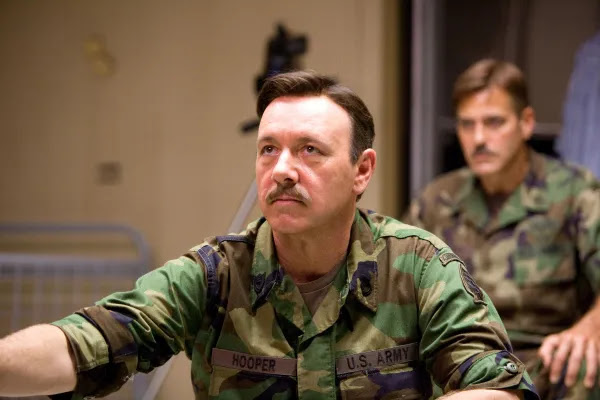
I think that Lyn Cassady might turn out to be one of my favorite roles portrayed by George Clooney. One, he gave a hilarious performance. And two, he also did a marvelous job in infusing Cassady’s role with a mixture of militaristic machismo and wide-eyed innocence. And despite his questionable American accent, I was very impressed by Ewan McGregor’s poignant performance as the lovelorn Michigan journalist (his wife left him for his editor), who traveled to Iraq to prove his bravery to his former wife . . . only to discover something more unique. Another joyous addition to the cast turned out to be Jeff Bridges, who gave a wonderfully off-kilter performance as Cassady’s mentor and founder of the New Earth Army, Bill Django. And Larry Hooper, the one man allegedly responsible for bringing down Django’s New Earth Army, turned out to be another one of Kevin Spacey’s deliciously villainous roles. The movie also featured performances that ranged from solid to zany from the likes of Stephen Lang, Robert Patrick, Nick Offerman, Waleed Zuaiter, Rebecca Mader and Glen Morshower.

"THE MEN WHO STARE AT GOATS" managed to earn less than $70 million dollars at the box office. Because it only had a budget of $24 million, it still managed to earn a small profit. However, it was not a hit film and it received mixed reviews. Perhaps the audience found the film's subject a bit hard to swallow. There is also the possibility that film goers found screenwriter Peter Straughan’s script use of constant flashbacks regarding the New Earth Army rather confusing. Personally, I rather enjoyed the movie. It never became a big favorite of mine, but I still found it entertaining and interesting.


Tuesday, October 28, 2025

"THE MEN WHO STARE AT GOATS" (2009) Photo Gallery


Below are photos from "THE MEN WHO STARE AT GOATS", the 2009 adaptation of Jon Ronson's 2004 book. Directed by Grant Heslov, the movie starred George Clooney, Ewan McGregor, Jeff Bridges and Kevin Spacey:


"THE MEN WHO STARE AT GOATS" (2009) Photo Gallery


Thursday, October 9, 2025

Controversial Finale: "BOARDWALK EMPIRE" (2.12) "To the Lost"


CONTROVERSIAL FINALE: "BOARDWALK EMPIRE" (2.12) "To the Lost"

The Season Two finale of "BOARDWALK EMPIRE"(2.12) "To the Lost" has been viewed as an end of an era for a good number of the series' viewers and television critics. It marked an event that left some fans satisfied and others in a state of anger and resentment. But one cannot deny that this event – along with a few others – allowed the series to enter a new phase for its third season. 

One of the changes that materialized in "To the Lost" turned out to be the marriage between Atlantic City's re-installed political boss, Enoch "Nucky" Thompson and his Irish-born mistress, the widowed Margaret Schroeder. Although both harbored feelings for each other, their marriage obviously seemed like one of convenience. Margaret had received a summons from Federal prosecutor Esther Randolph as a possible witness against Nucky for her husband’s murder back in Season One. By "To the Lost", Margaret had embraced religion as a reaction to her daughter becoming a victim of the polio outbreak. When Nucky learned about her summons, he asked her to marry him in order to prevent her from testifying against him and to avoid serving time in prison. Margaret agreed. But she had also hoped to convince Nucky to do the same – before and after the charges against him were dropped. To her disappointment, Nucky revealed no interest in embracing religion. Worse, he had signed over a piece of valuable property to Margaret, when he feared that the Federal government might confiscate his possessions. 

When Margaret learned about the murder of Alderman James Neary – an enemy of Nucky's – she immediately assumed he was behind the crime. As it turned out, she was wrong. Nucky's former protégée, Jimmy Darmody, had committed the deed with friend Richard Harrow’s help, in an effort to win the political boss' forgiveness for his betrayal. However, Margaret went ahead and signed over Nucky’s land to the Catholic Church. The ironic aspect of Margaret’s reasoning behind her actions was that she harbored a secret of her own. In the season’s seventh episode, (2.07) "Peg of Old", she had sex with Owen Sleater, Nucky’s new bodyguard. This happened at a time when Nucky was facing an assassination attempt arranged by Jimmy. Margaret eventually found the nerve to confess her infidelity to the local priest and to God. Margaret seemed willing to judge Nucky for his lies – real and imagined. Yet, she had failed to find the courage to confess her sin of infidelity to Nucky.

Albert "Chalky" White, the unofficial leader of Atlantic City’s African-American community, had to endure numerous difficulties during Season Two. The Ku Klux Klan attacked his bootleg operation in the season’s premiere episode,(2.01) "21", resulting in the deaths of several of his men. Chalky managed to kill one of the Klansmen during the attack. He ended up being charged with murder. Nucky's attorney managed to get him out of jail on bail, but Chalky still faced a trial. This ended when Jimmy managed to get the State Attorney’s office to drop the murder charges. Jimmy, along with Richard’s help, attacked a Klan gathering at gunpoint, shot two men and demanded the men who had attacked Chalky’s warehouse in "21". After delivering the men to Chalky and the latter’s new right-hand man, former jail cell nemesis Dunn Purnsley, Jimmy asked the former to contact Nucky on his behalf. This arrest would lead to the first of two meetings between Jimmy and Nucky and the former's controversial death that ended Season Two.

Like many other fans of "BOARDWALK EMPIRE", I had made the mistake of assuming that Nucky would eventually forgive Jimmy for his Season Two transgressions. After all, the Jimmy Darmody character was the second lead in the series. After watching "To the Lost", I realize that I had been living in a fantasy. So had Jimmy. The deaths of his wife Angela and father, the Commodore, in (2.11) "Under God's Power She Flourishes", had left him shaken to his core. I suspect this also led him to realize it would be in his best interest to seek forgiveness from Nucky. Jimmy engaged in a campaign to make up for his past transgressions – which included a murder attempt on Nucky. With Richard’s help, he nabbed the Klansmen who was responsible for the attack on Chalky’s bootlegging operation; set up both Alderman Jim Neary and Eli Thompson for election fraud, before faking Neary’s death as a suicide; and claimed that Eli was responsible for introducing the idea of a hit on Nucky. But all of this did not work. It was Richard who pointed out that no matter what Jimmy did, Nucky would never forgive him.

Now that I think about it, I found myself wondering why Jimmy had never considered the possibility that Nucky was not the forgiving type . . . until it was too late. Surely he must have remembered Nucky's reaction when he and Al Capone had stolen Arnold Rothstein's whiskey shipment in the series' premiere, (1.01) "Boardwalk Empire". Nucky had been so angry that he fired Jimmy as his driver and demanded that the World War I veteran pay $3,000 as compensation for committing the robbery in his town and without his consent. Jimmy was forced to flee from Atlantic City to Chicago, when a witness to the heist reappeared. And even though Nucky asked Jimmy to return to help him deal with his war against Rothstein, he remained angry over the heist. Now if Nucky was unable to completely forgive Jimmy for the whiskey heist in Season One; his chances of forgiving the younger man for an attempted murder seemed pretty moot. And no one - including myself - seemed to realize this.

I am not condoning Nucky's murder of Jimmy. I believe that what he had done was wrong. But I must admit that I found some of the outraged reactions against the crime rather puzzling. Although some had expressed disappointment over Jimmy's sanction of the murder attempt on Nucky in "Peg of Old", the level of anger toward Jimmy seemed particularly mute in comparison to their anger toward Nucky for his actions in "To the Lost". This same television season (2011) had also seen the death of lead actor Sean Bean in another HBO series, "GAME OF THRONE". Some had expressed surprise at the turn of events, but not anger. 

Some fans had pointed out that it was Nucky's younger brother and Atlantic City's sheriff, the resentful Eli Thompson, who had initiated the idea of killing Nucky. Jimmy even informed Nucky of Eli's participation in the murder attempt. I suspect that Nucky had suspected that Jimmy had told the truth. But he had considered two things. One, Eli was his brother. And two, it was Jimmy who had given the final decision to have Nucky killed. In the end, even Eli had failed to completely escape Nucky's wrath. Although his life was spared, the political boss forced his younger brother to plead guilty to the corruption charges and face at least two years in prison (or less with parole). Something tells me that Eli's career as Sheriff of Atlantic County had ended permanently.

Jimmy had also been wrong to order the hit on Nucky. Yet, the level of anger toward his act was barely minimal. Were these fans upset that Nucky had succeeded, where Jimmy had failed? Or was their anger due to the loss of the younger and good-looking Michael Pitt, who had NOT been the series' lead? Because no one had expressed similar sentiments over the Sean Bean's departure from "GAME OF THRONES". Was this major outrage over Jimmy's death had more to do with superficial preference than moral outrage?  It seemed so to me.

I had enjoyed Michael Pitt's portrayal of the troubled Jimmy Darmody, during his two-year stint on "BOARDWALK EMPIRE". But unlike many other fans, I cannot accept the views of some that the series had jumped the shark with his character's death. I refuse to claim that the series' quality will remain the same, or get better or worse. I can only make that judgment after Series Three has aired. But the very talented Steve Buscemi remains at the lead as Enoch "Lucky" Thompson.  And the series managed to continue on, guided by creator Terence Winter.  The number of changes that marked "To the Lost" and Season Two, proved to be mere hints - and rather large ones at that - of things to come in future seasons.


Saturday, September 20, 2025

"ADAM BEDE" (1991) Review


"ADAM BEDE" (1991) Review

Recently, I had come across an old BBC production that I have not seen in years. The production was a television movie based upon author George Eliot's first novel, "Adam Bede".

This adaptation of Eliot's 1859 novel told the story of four young people from the rural English community of Hayslope around the end of the 18th century. This "love rectangle" revolved around a local carpenter named Adam Bede; a beautiful, yet self-absorbed milkmaid named Hetty Sorrel; the local squire's charming grandson and heir, Captain Arthur Donnithorne; and Hetty's cousin Dinah Morris, a beautiful Methodist lay preacher who is also attracted to Adam. How did this "rectangle" come about? Although highly regarded by the Hayslope community as an intelligent and talented carpenter, Adam has a weakness . . . namely his passionate and unrequited love for the beautiful Hetty. Unfortunately for Adam, Hetty was deeply in love, lust or simply dazzled by the handsome and charming Arthur. Did Arthur love Hetty? I honestly do not know.

As I had stated earlier, "Adam Bede" was George Eliot's first novel. Eliot's earlier skill as a writer is very apparent in this television adaptation. Do not get me wrong. I rather enjoyed "ADAM BEDE" very much. But it did not strike me as . . . fascinating or complex as other George Eliot adaptations I have seen. If one must be honest, the whole "servant girl get seduced by rich young man" scenario is not particularly new. I suspect that it was not new when Eliot wrote this novel back in the 1850s. I believe that Eliot had used this trope again when she wrote "Silas Marner", which was published two years after this first novel. Both stories featured "fallen women" and both portrayed the latter in a slightly unsympathetic light. Mind you, Eliot did a good job in conveying Hetty's struggles between the discovery of her pregnancy and the verdict during her trial. But I could not help but suspect a slight taint of Victorian morality in Eliot's portrayal of Hetty. I believe screenwriter Maggie Wadey tried her best to overcome that rigid morality, but thanks to the narrative, I do not think she had fully succeeded. Especially when one considers how "ADAM BEDE" ended.

If I have a real problem with "ADAM BEDE", it is the ending. If the production had been a two-part movie, perhaps . . . You know what? I suspect that stretching out the running time would not have solved what I believe was the narrative's main problem. I believe changing the ending would have helped. One problem proved to be Hetty's fate. After being found guilty of infanticide, Hetty was sentenced to execution. Her sentence was commuted to penal transportation to Australia at the last moment, thanks to Arthur Donnithorne. Ye-ee-ea-ah . . . I found this scenario a bit improbable. It seemed as if Eliot had tacked on this last minute fate for Hetty to avoid a truly tragic ending. Another problem I had with the ending proved to be the main protagonist's relationship with the Dinah Morris character. The movie featured a brief scene in which Adam Bede regarded Dinah as an attractive woman. Despite this, he spent most of the production harboring a passionate, almost possessive love for Hetty Sorrel. Once Hetty was sent away for transportation, Adam became romantically interested in Dinah. Rather fast. Too fast, if you want my opinion. I realize that he was urged to consider Dinah as a romantic partner by others, but . . . yeah, I thought the final romance between the pair happened too fast.

However, "ADAM BEDE" had its virtues. One, the production did an excellent job in conveying the mores and traditions of a rural town in Britain at the end of the eighteenth century. I found it amazing how the town's middle and lower classes were judged a bit more harshly than the upper-class residents. I noticed that although Adam is not regarded as morally questionable, many others tend to judge him based upon his moral compass . . . a lot. I also noticed that many seemed to regard Arthur's morals with a wary eye, they seem willing to give him a pass. I doubt they would have been that generous with Adam. But that is always the case, is it not . . . at least for those who are not part of an elite social group.

If middle and lower-class men had it bad, women of all classes had it worse. Dinah Morris is portrayed as a decent and pious woman. Yet, there seemed to be a slight air of disapproval directed toward Dinah, due to her role as a Methodist lay preacher. But no one is judged more harshly than Hetty Sorrel. Even by Eliot. Audiences are expected to harshly judge Hetty for her desire for a life "above her station". But I will give credit to both Eliot and screenwriter Maggie Wadey for injecting a great deal more of ambiguity and sympathy toward Hetty . . . especially after she became pregnant.

I also have to commend the movie's performances. There was not a bad one in the bunch. Susannah Harker made a very serene Dinah Morris, even I did not find the character particularly interesting. James Wilby had a more interesting character to portray, namely the shallow and sensual Arthur Donnithorne. However, I do not think Wadey's screenplay really gave the actor much of a chance to explore Arthur's ambiguity, aside from one or two scenes. "ADAM BEDE" also featured excellent performances from Jean Marsh, Paul Brooke, Robert Stephens, Freddie Jones, Michael Percival and Alan Cox.

Julia McKenzie struck me as particularly memorable as Mrs. Poyser, the aunt of both Dinah and Hetty. Although Eliot had written her as a comic figure, the actress managed to inject a good deal of pathos and emotion into the character, thanks to the screenplay. Patsy Kensit was superb as the flighty, yet hard-luck Hetty Sorrel, who proved to be the most interesting character in this tale. Kensit managed to skillfully rise the character's one-dimensional portrayal in the movie's first half and embrace the ambiguous quagmire that poor Hetty ended up in the second half. Superficially, Adam Bede did not seem as ambiguous as Hetty. Superficially. But underneath the stalwart and industrious carpenter existed a proud and emotional man, whose world centered around a woman who did not love him. And man did the producers select the right man to portray young Adam - namely Iain Glen. I have been aware of the actor for several decades. And I have noticed that whether he was playing a hero, a villain, anti-hero - you name it - Glen has always managed to convey the emotional depths behind his characters on a level that very few actors have managed to achieve . . . whether through his voice or expressions. Or perhaps both. And he utilized the same level of skill in his portrayal of the emotional and lovelorn Adam. No wonder I have been a fan of his for years.

Overall, I would never regard "ADAM BEDE" as one of my favorite George Eliot adaptations. The problem is that the movie reflected too much of the novel's narrative flaws. But not all was lost with Maggie Wadey's adaptation. I still managed to enjoy the movie, thanks to its intriguing plot and first-rate cast led by Iain Glen. In the end, I believe it had more virtues and flaws.


Friday, August 1, 2025

"BOARDWALK EMPIRE": Echoing John Webster


"BOARDWALK EMPIRE": ECHOING JOHN WEBSTER

One of the flashbacks in the most recent episode of "BOARDWALK EMPIRE" featured a scene with the future Atlantic City crime lord, Jimmy Darmody, discussing the English dramatist John Webster's 1612 play, "The White Devil" with his class at Princeton University. After watching the entire episode, it occurred to me that another one of Webster's plays could have served as a reference.

I have never posted an article about an episode of "BOARDWALK EMPIRE" during these last two seasons. I have posted a gallery featuring images and a list of favorite episodes from Season One. But after watching (2.11) "Under God's Power She Flourishes", I realized that I could not keep my mouth shut. Or at least refrain from writing something about it. What can I say? It blew my mind. Even more so than the previous episode, (2.10) "Georgia Peaches".


"Under God's Power She Flourishes" featured the deterioration of the relationship between former Atlantic City political boss Nucky Thompson and his Irish-born mistress, Margaret Schroeder. Margaret has been sagging under the belief that her sins - both past and recent - led to divine retribution in the form of her daughter Emily being struck down by polio. Margaret had hoped that a financial contribution to the Catholic Church would lead God to alleviate her daughter's pain. When that failed, she decided that the only way to satisfy God would be to consider testifying against Nucky, regarding the murder of her late husband, Hans Schroeder. Naturally, Nucky is both disturbed and greatly peeved by Margaret's suggestion. He thought he had finally nipped in the bud the possibility of being convicted by the U.S. Department of Justice for Schroeder's murder. Nucky and his attorney had learned from the former's servant about Treasury Agent Nelson Van Alden's murder of fellow colleague Agent Sebso back in Season One.

Like Margaret, Van Alden had hoped that his recent actions - turning over his files on Nucky to Federal prosecutor Esther Randolph, granting his wife a divorce and resisting Mickey Doyle's suggestion that he raid a bootlegging operation ran by Charlie Luciano, Meyer Lansky and Al Capone in exchange for a bribe - would lead God to prevent him from any further suffering or encountering further retribution for his crimes and sins. Instead, Esther Randolph reminded him of Agent Sebso's murder and Van Alden found himself a fugitive from Federal justice. Looking at Margaret and Van Alden's hopes and disappointments, I cannot help but wonder if their idea of embracing God called for some kind of business deal for their safety or the safety of loved ones.

But the meat of "Under God's Power She Flourishes" picked up several hours after "Georgia Peaches" ended. Angela Darmody, who had been murdered by Philadelphia mobster/butcher Manny Horvitz in retaliation for a murder attempt, was being carried away by a coroner's truck. A sheriff deputy questioned mother-in-law Gillian Darmody and Richard Harrow on the whereabouts of Angela's missing husband, Jimmy. Jimmy had traveled to Princeton to unload a supply of bootleg whiskey he was unable to sell in Atlantic City. The news of Angela's death, some booze and Luciano's sample of heroin led to Jimmy recalling his last days at Princeton, before he joined the U.S. Army to fight World War I.


I tried to recall other "BOARDWALK EMPIRE" episodes that had relied on flashbacks, but none came to mind. I have no opinion on the use of flashbacks one way or the other, as long as they manage to serve the episode or movie in question. The Princeton flashbacks certainly served this latest "BOARDWALK EMPIRE" episode, as far as I am concerned. The flashbacks explained a great deal about Jimmy's character and especially his relationships with both his mother Gillian and Angela, who had been a waitress at a local cafe when she and Jimmy first became involved. Jimmy and Angela's pre-marital affair led to son Tommy's conception. The flashbacks also featured Gillian's visit to Princeton, where she met Angela for the first time. It seemed pretty obvious that Gillian did not care for her son's new lady love. I can only wonder if Gillian's feelings toward Jimmy's romance with Angela led her to do what she did that evening. It was bad enough that she had briefly become involved with Jimmy's professor - the one with whom he discussed John Webster. But what she did later - seduce Jimmy into having sex with her - left my head spinning and the Internet buzzing over the incident. The night of incest between mother and son also led the latter to join the Army to escape facing their deed.


But Jimmy could not avoid facing Gillian forever. He eventually returned home to Atlantic City in order to work for Nucky and raise Tommy with Angela by his side. Jimmy also renewed his relationship with Gillian - without any sex being involved, thank goodness. Unfortunately, I suspect that incestuous night at Princeton had left its mark on Jimmy. It may have damaged his psyche considerably. And it may have also led him to make major mistakes such as joining Gillian and his father, former political boss Louis "the Commodore" Kaestner, to betray Nucky, his mentor. It led him to join forces with Luciano, Lansky and Capone, to form their own criminal organization. It, along with pressure from both Eli Thompson and Gillian, led him to organize an unsuccessful hit on Nucky. And it may have led him to commit his two biggest mistakes - welch on a $5,000 payment to Manny Horvitz and suggest that another gangster named Waxy Gordon kill the Philadelphia mobster/butcher. In the end, Angela ended up dead, Tommy motherless and Jimmy finally unable to hold back the memories of the Darmodys' Princeton sexcapade.

But it got worse. Upon his return to Atlantic City in the present, Jimmy found Gillian crowing over Angela's death. With her "rival" gone, I can only assume Gillian saw no need to hide her true feelings about the former "underweight waitress". But her crowing only ignited rage within Jimmy and led him to strangle her. The timely and rather surprising intervention by the recovering Commodore saved Gillian's life. But after stabbing Jimmy's shoulder with an antique spear, Jimmy stabbed his father with a trench knife. Another surprise appeared out of the blue when Gillian, with flashing eyes and a sharp tone, barked at Jimmy to finish the job and kill his father. Which he did. Many fans have compared Jimmy to the mythical Greek tragic hero, Oedipus. But the latter never knew that the man he had killed and woman he married were his parents. Jimmy, probably to his everlasting regret, did not possess such a luxury. But the sight of Gillian carrying Tommy upstairs, while stating that the latter will grow someday, and reminding him of the location of her bedroom, seemed to have left Jimmy wondering if his life had made an even uglier turn.


As for poor Angela . . . did anyone mourn her? Gillian certainly did not. I believe Jimmy did. But his grief seemed to be entwined with guilt over the suspicion that he became involved with Angela for the wrong reasons. Tommy is not even aware that his mother is dead, thanks to Gillian's lie about Angela departing for Paris for a bit of fun. The only one left is hitman Richard Harrow, whose brief and silent regard of Angela's blood made it obviously clear - at least to me - that he will miss her friendship very much. She was the only one who was able to face his disfigurement and situation with an open mind that not even Jimmy completely possessed. But Richard proved that he still had Jimmy's back, when he got rid of the Commodore's body on behalf of his friend.


Jimmy and Gillian's night of incest was shocking, but not really surprising. The series has hinted an incestuous vibe between them since the series' second episode, (1.02) "The Ivory Tower". In this episode, Jimmy finally revealed his return from the Army to Gillian, when he greeted her with a present, backstage at the at the Cafe Beaux-Arts nightclub. I still recall that moment when the two first laid eyes upon each other. A scantily-clad Gillian jumped into his arms and rained kisses on his face before admonishing him for not writing. Jimmy eventually asked her to put some clothes on and handed her a present - a necklace. At first, I thought Gillian was another girlfriend that he kept a secret from Angela. But when he called her "Mom", I found myself in complete shock. What mother would greet her grown son in a scantily-clad costume, by jumping into his arms before wrapping her legs around him? That was the first of many weird moments between Jimmy and Gillian that eventually escalated into that mind-blowing flashback. Some viewers and critics are complaining that the incest came unexpectedly and out of right field. Frankly, I believe they were not paying close attention to the relationship between mother and son.

One of the ironies about the episode is that "Under God's Power She Flourishes" is the motto of Princeton University, the site of Jimmy and Gillian's night of infamy. However, the biggest irony for me turned out to be the Commodore's death. I found it interesting that his death came from his attempt to act as an aging knight-in-armor for Gillian, the very woman he had raped when she was 12 or 13 years-old. In a twisted way, the Commodore's necrophiliac tendencies ended up costing him his life, a quarter of a century later. I did find myself wondering why the Commodore had attempted to save Gillian's life in the first place. Had he grown fond of her during those last months with her and Jimmy in his home? Or did Gillian's bitter recollection of the rape finally brought forth some form of guilt on his mind? I guess we will never know.

And how did John Webster fit into all of this? Jimmy's discussion with his professor about the dramatist's "The White Devil" and the latter's drunken entanglements with the visiting Gillian led to a declaration that Jimmy's life was one Jacobean saga. Webster's tales involved a great deal of tragedy, corruption, murder . . . well, you get the picture. Even the topic of incest had made its way into Webster's works - especially in his 1612-13 play, "The Duchess of Malfi". In that story, the female lead, the Duchess of Malfi, was murdered by her two brothers - in which one of them harbored incestuous feelings for her - after she married beneath her class. Well, the only person Jimmy murdered was the Commodore. But I find it rather interesting that Jimmy and Gillian's incestuous tryst inadvertently led to the Commodore's death.

Some people have expressed fears that the Season Two finale will never be able to top this episode. Frankly, I also rather doubt it will. "Under God's Power She Flourishes" struck me as one of those episodes that many will remember for years to come. I really do not see how (2.12) "To the Lost" will be able even better. I do not see how any episode could top "Under God's Power She Flourishes" so soon. Then again, I had no idea that Terence Winter and his writers would top a first-rate episode like "Georgia Peaches" with the next one. In the end, I can only hope that the Season Two finale would end up being entertaining and interesting in the long run.

Sunday, July 27, 2025

"ADAM BEDE" (1991) Photo Gallery


Below are images from "ADAM BEDE", the 1991 adaptation of George Eliot's 1859 novel. Adapted by Maggie Wadey and directed by Giles Foster, the television movie starred Iain Glen:


"ADAM BEDE" (1991) Photo Gallery


"BAND OF ANGELS" (1957) Review

  "BAND OF ANGELS" (1957) Review I have been a fan of period dramas for a long time. A very long time. This is only natural, consi...