Showing posts with label middle east. Show all posts

Wednesday, February 4, 2026

"APPOINTMENT WITH DEATH" (1988) Review


"APPOINTMENT WITH DEATH" (1988) Review


Agatha Christie's 1938 novel, "Appointment With Death" has proven to be a problem over 80 years or so. If I must be honest, it is not a great novel. Considering the topic of emotional abuse, it had the potential to be great. But I feel that Christie never achieved what could have been a memorable and haunting tale.

The novel also produced adaptations in the form of a 1945 stage play, a 2008 television movie and a 1988 theatrical release. Of the three adaptations, the 1988 film, "APPOINTMENT WITH DEATH" came the closest in being faithful to novel. Is it the best adaptation? Unfortunately, I have never seen the stage play and have no idea what changes to Christie's plot had been made. I have seen the 2008 television movie. And honestly? I consider it a colorful travesty. Do I harbor the same opinion of the 1988 film? Well . . . no. It is not a bad film. But I believe it is a far cry from some of the best of the Christie adaptations.

Directed by Michael Winner, "APPOINTMENT WITH DEATH" centered on Belgian-born detective Hercule Poirot's investigation into the death of a wealthy middle-aged woman named Mrs. Boynton. Actually, the story began several months earlier, in New Jersey, where the recently widowed Mrs. Boynton learned that her late husband left a second will would enable her stepchildren and daughter to enjoy a financially stable life, independent of her. Jealous of the idea of no longer holding any power over her family, Mrs. Boynton blackmailed the family attorney, Jefferson Cope, into destroying the second will, leaving her in charge of the family finances. The family embarks on a grand tour of Europe and the Holy Land during the spring of 1937. During the sea voyage between Italy and the Middle East, fellow passenger Hercule Poirot overhears two of Mrs. Boynton's stepchildren, Raymond and Carol, discussing the possibility of their stepmother's death. More importantly, Mrs. Boynton is surprised by the appearance of Cope, fearful he might inform her children about her husband's second will.

Following the characters' arrival in Petra, Poirot and some of the other characters become aware of Mrs. Boynton's domineering abuse of her stepchildren and daughter. One of the vacationers, a Dr. Sarah King, falls in love with one of Mrs. Boynton's stepsons - Raymond. But she becomes frustrated by his inability to break free of his stepmother's grip. Sarah's frustrations reflect those of Nadine Boynton, who is near the breaking point over her husband's inability to break free from his stepmother. Also, the old lady's stepchildren are becoming increasingly worried over Mrs. Boynton's poisonous influence over the latter's only child and their half-sister, Ginerva. Things come to a boil during a one day expedition to an archeology dig outside Petra. A few hours after Mrs. Boynton encourages her family to go for a walk, she is discovered dead. It does not take Poirot very long to figure out that the old lady had been murdered. And he is recruited by the region's British Army representative, Colonel Carbury, to investigate her death.

As I had earlier stated, "APPOINTMENT WITH DEATH" is not a bad film. But it is certainly no masterpiece. Let me be frank. It is quite obvious that the look and tone of this production is more akin to television movie feature from "AGATHA CHRISTIE'S POIROT" than a theatrical movie. It is a bit cheap in compare to star Peter Ustinov's previous two Poirot movies and the 1974 one that starred Albert Finney. Some of cast members seemed to be going through the motions in their performances. This especially seemed to be the case for Carrie Fisher, Nicholas Guest, John Gielgud and sadly, Peter Ustinov. And when the star of the film seemed almost too relaxed or uninterested in his performance or the film, there is potential for disaster. What makes this sad is that Ustinov gave a funny and energetic performance for his next role as Detective Fix in the 1989 miniseries, "AROUND THE WORLD IN 80 DAYS". Adding to the film's second-hand look was Pino Donaggio's very disappointing score. Honestly, it was probably the worst movie score for any Agatha Christie's production I have ever heard. It seemed to be 1980s pop music at its cheesiest. And allowing a cheesy 80s pop tune to serve as the main score for a movie set in the late 1930s was one of the worst mistakes that Michael Winner and the other film's producers made.

But all is not lost. At least Winner can claim he directed the better version of Christie's 1938 novel. The television movie adaptation made twenty (20) years later seemed like a total disaster in compare to this film. And the 1988 movie had more virtues. Although the movie's production visuals seemed a bit of a comedown from the Christie movies between 1974 and 1982, production designer John Blezard's work in "APPOINTMENT WITH DEATH" still struck me as pretty solid. I was especially impressed by his work, along with Alan Cassie and Shlomo Tsafrir's set designs and David Gurfinkel's photography during the archeological dig sequence. John Bloomfield's costume designs also struck me as pretty solid, but not exactly mind-blowing. Despite Michael Winner's pedestrian direction and the less-than-spectacular production, I have to admit that Winner, Anthony Shaffer and Peter Buckman did a very admirable job of adapting Christie's novel. I am not saying this because it is more faithful than the 1945 stage play and the 2008 television movie. The three screenwriters made some changes to the plot - including the deletion of one or two characters - but those changes did not harm the story overall.

Most of the cast certainly injected a good deal of energy, despite Ustinov, Fisher, Guest and Gielgud's lethargic performances. I was especially impressed by Jenny Seagrove as the stalwart Dr. Sarah King, David Soul's sly performance as the Boyntons' slippery, yet charming attorney Jefferson Cope, and John Terlesky's earnest performance as Raymond Boynton. As far as I am concerned, both Lauren Bacall and Hayley Mills gave the funniest performances in the film. Bacall's hilarious portrayal of the rude and pushy American-born Lady Westholme almost reminded me of her performance as the verbose Mrs. Hubbard from 1974's "MURDER ON THE ORIENT EXPRESS". However, her Lady Westholme struck me as funnier. And Hayley Mills was equally funny as Lady Westholme's impromptu traveling companion, the obsequious Miss Quinton. But the engine that really drove "APPOINTMENT WITH DEATH" turned out to be Piper Laurie's performance as murder victim, Mrs. Emily Boynton. There were moments with Laurie's performance became somewhat hammy. But she did a great job in portraying a manipulative and emotionally sadistic woman with a talent for keeping her stepchildren in line. I found her performance very commanding.

Overall, I would not consider "APPOINTMENT WITH DEATH" to be one of the best movie adaptations of a Christie novel. Heck, I can think of several television movie adaptations that I would view as better. But I believe it is the better of the two adaptations of the 1988 novel. I wish I could say that director Michael Winner and Peter Ustinov's performance as Hercule Poirot contributed a good deal to this movie's production. But it was not that difficult for me to see that Winner is at heart, a mediocre director. And Ustinov's performance seemed at worst, lethargic. And yet, the rest of the cast (aside from two others) and a solid script prevented "APPOINTMENT WITH DEATH" from sinking into a mire of crap. At least for me.


Sunday, January 25, 2026

"THE MEN WHO STARE AT GOATS" (2009) Review


"THE MEN WHO STARE AT GOATS" (2009) Review

Grant Heslov directed this comedic adaptation of Jon Ronson’s 2004 book about the U.S. Army's exploration of New Age concepts and the potential military applications of the paranormal. The movie starred George Clooney as one of the participants in this program and Ewan McGregor, who portrayed a journalist who stumbles across the story, while reporting on businesses with military contracts in Iraq.

One of the surprising aspects about "THE MEN WHO STARED AT GOATS" is that its story is based upon fact. According to author Jon Ronson, there was actually a similar unit actually existed within the U.S. Army called the Stargate Project. The film featured a different name for the units . . . and had probably changed some of the facts, but the Army did explore New Age concepts and military applications of the paranormal. "THE MEN WHO STARED AT GOATS" followed McGregor’s character, a journalist with the Ann Arbor Daily Telegram named Bob Wilton. After an emotional divorce from an unfaithful wife, Bob goes to Kuwait to report on the Iraq War. He stumbles upon an interesting story when he meets a Special Forces operator named Lyn Cassady during a trip across the Iraqi countryside. During the road trip, Cassady reveals his participation in an Army unit that trained to develop a range of par psychological skills by using New Age concepts. The unit ended up being named the New Earth Army. While the pair endured a journey that included encounters with a gang of Iraqi criminals, a kidnapped victim of the criminals, the head of a private security firm named Todd Nixon and two rival groups of American contractors who engage in a gunfight against each other in Ramadi.

During Wilton and Cassady’s journey, the latter revealed the story behind the creation of the New Earth Army and its founder, a Vietnam War veteran named Bill Django. The latter had traveled across America in the 1970s for six years to explore a range of New Age movements (including the Human potential movement) after being wounded during the Vietnam War. Django used these experiences to create the New Earth Army. Django’s recruits ended up being nicknamed "Jedi Warriors". By the 1980s, two of Django's best recruits were Cassady and Larry Hooper, who developed a lifelong rivalry with the former because of their opposing views of how to implement the First Earth philosophy. Cassady had wanted to emphasize the positive side of the teachings, whereas Hooper was more interested in the negative side of the philosophy. Wilton and Cassady’s journey ended when they locate a military base in the middle of the desert.

I must admit that I had not in a big hurry to see "THE MEN WHO STARE AT GOATS" when it first hit the theaters ten years ago. In fact, I never had any intention of seeing it. The only reason I went to see the movie in the first place was that I was desperate for something to watch. The Fall 2009 movie season had seemed pretty dim to me. Aside from "THE INFORMANT", I had difficulty finding a movie that appealed to me. And what about "THE MEN WHO STARE AT GOATS"? Did I find it appealing? Honestly? It was not the best movie I had seen in 2009. But I must admit that thanks to Grant Heslov’s direction and Peter Straughan’s screenplay, I found the movie rather humorous in an off-kilter manner. Some of the most humorous scenes featured:

*Wilton and Cassady’s flight from a group of Iraqi criminals

*The "Battle of Ramadi" between two American private security armies

*Bill Django’s six year exploration of New Age movements

*The results of Wilton and Django’s spiking of the Army base food with LSD.


At first, the movie’s approach to New Age religion and movements seemed inconsistent. The first half of the film treated the subject as a joke. However, once Wilton and Cassady reached the base housing the PSIC, Straughan’s script treated the subject with a lot more respect. It took me a while to realize that the story was told from Bob Wilton’s point-of-view. It only seemed natural that he would first view the New Earth Army and New Age beliefs as a joke. But after time spent with Cassady and later Django at the PSIC base, Wilton naturally developed a newfound respect for both topics. The movie also provided a slightly pointed attack upon the U.S. military presence in Iraq. Normally, I would have cringed at such protesting in a comedy. Fortunately, Heslov used humor – and very sharp humor at that – to mock American presence in the Middle Eastern country.

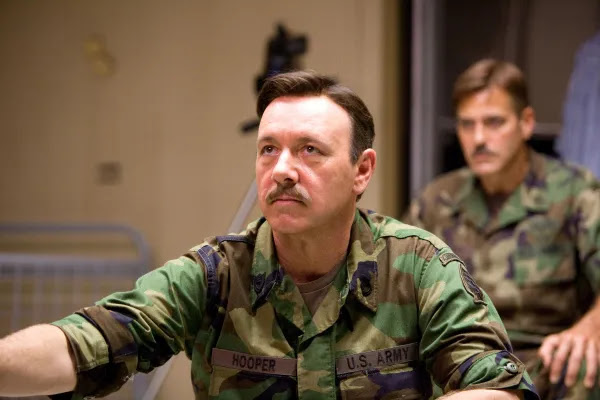
I think that Lyn Cassady might turn out to be one of my favorite roles portrayed by George Clooney. One, he gave a hilarious performance. And two, he also did a marvelous job in infusing Cassady’s role with a mixture of militaristic machismo and wide-eyed innocence. And despite his questionable American accent, I was very impressed by Ewan McGregor’s poignant performance as the lovelorn Michigan journalist (his wife left him for his editor), who traveled to Iraq to prove his bravery to his former wife . . . only to discover something more unique. Another joyous addition to the cast turned out to be Jeff Bridges, who gave a wonderfully off-kilter performance as Cassady’s mentor and founder of the New Earth Army, Bill Django. And Larry Hooper, the one man allegedly responsible for bringing down Django’s New Earth Army, turned out to be another one of Kevin Spacey’s deliciously villainous roles. The movie also featured performances that ranged from solid to zany from the likes of Stephen Lang, Robert Patrick, Nick Offerman, Waleed Zuaiter, Rebecca Mader and Glen Morshower.

"THE MEN WHO STARE AT GOATS" managed to earn less than $70 million dollars at the box office. Because it only had a budget of $24 million, it still managed to earn a small profit. However, it was not a hit film and it received mixed reviews. Perhaps the audience found the film's subject a bit hard to swallow. There is also the possibility that film goers found screenwriter Peter Straughan’s script use of constant flashbacks regarding the New Earth Army rather confusing. Personally, I rather enjoyed the movie. It never became a big favorite of mine, but I still found it entertaining and interesting.


Thursday, November 27, 2025

"THE FIFTH ESTATE" (2013) Review


"THE FIFTH ESTATE" (2013) Review

The subject of WikiLeaks has been something of an conundrum for me. I have been aware of the series of news stories about the website and its founder and spokesperson, Julian Assange and Daniel Domscheit-Berg for years. But I must be honest . . . my thoughts on the whole matter tend to disappear at least a few minutes after hearing or reading about it. So when news of a film about WikiLeaks was announced, I found myself surprised by the online reaction to the news.

"THE FIFTH ESTATE" drew its title from a term that describes a group that operates outside of the society's normal groups, especially one that is considered beyond the restrictions or rules of those others. A "fifth estate" is strongly associated with journalists and media outlets viewed outside of or in opposition to the mainstream media or official press. This term could easily describe WikiLeaks, the Internet website and organization that publishes secret information, news leaks, and classified media from anonymous sources. The movie, which is directed by Bill Condon, is based upon Domscheit-Berg's book "Inside WikiLeaks: My Time with Julian Assange and the World's Most Dangerous Website" and "WikiLeaks: Inside Julian Assange's War on Secrecy" by journalists David Leigh and Luke Harding. Both were published in 2011. The movie follows the association between Assange and Domscheit-Berg, from their 2007 meeting at the Computer Chaos Club in Berlin to their estrangement over the Afghan War Logs. Judging from the movie's source of material, it is easy to see that the story is mainly told from Domscheit-Berg's point of view.

Is it a good movie? Many critics and filmgoers seem to believe otherwise. They directed their negative criticism toward Josh Singer's screenplay and Bill Condon's direction. In fact, many also believe it was a mistake for the movie to be told either from Domscheit-Berg's point of view or those in the U.S. intelligence service. I now feel they were right in regard to the movie's points-of-view. After all Assange proved to be the movie's main topic in the end. I now feel that "THE FIFTH ESTATE" would have benefited from balanced viewpoints of both Domscheit-Berg and Assange. There were a few other aspects of "THE FIFTH ESTATE" I found a little troubling. There were moments when I could not ascertain some of the dialogue. I do not if this was due to the movie theater's sound system or the performances in the film. "THE FIFTH ESTATE" also featured a set - an office space filled with desks - that served as a visual metaphor of the WikiLeaks website. Honestly, I found this so-called metaphor rather irrelevant and ham-fisted.

However, "THE FIFTH ESTATE" had its good points. I thought Bill Condon's direction of the film to be solid and well-paced. He was ably assisted by Tobias Schliessler's sharp cinematography and Virginia Katz's skillful editing. Condon also did an excellent job of injecting suspension in a tale that focused on the Internet. I feel that he and screenwriter Josh Singer were right to include the consequences of the Afghan War Logs exposure in a few sequences featuring a Libyan doctor with political ties named Tarek Haliseh, who served as an informant for U.S. intelligence. Despite the film's failure to focus some of its story from Assange's viewpoint, I must admit that I found the movie's plot very interesting. Thanks to "THE FIFTH ESTATE", I managed to maintain my interest in WikiLeaks a lot longer than ten minutes or less.

I cannot deny that "THE FIFTH ESTATE" greatly benefited from a talented cast. Benedict Cumberbatch gave a very interesting performance as colorful creator of WikiLeaks, Julian Assange. I have no idea if the latter was satisfied with Cumberbatch. And there is a good chance (or not) that the characterization was off. If it was off, then one must place the blame on Singer's screenplay, not Cumberbatch's skillful performance. A less skillful actor could have easily been overshadowed by Cumberbatch's performance. Fortunately, Daniel Brühl was talented enough to make Daniel Domscheit-Berg a fascinating character in his own right - especially in scenes that conveyed the latter's frustrations with the Assange character. A third performance that caught my eye came from David Thewlis, who was equally colorful as British journalist Nick Davies, who covered WikiLeaks' exposure of the Afghan War Logs. I was also impressed by Laura Linney, who did an excellent job in conveying the U.S. intelligence services' anger and frustration toward the WikiLeaks website. The movie also featured solid performances from Stanley Tucci, Alicia Vikander, Dan Stevens, Alexander Siddig, Peter Capaldi, Moritz Bleibtreu and Anthony Mackie. However, I was disappointed by the film's minimum use of Mackie. For someone listed third in the cast, he had a very small role.

Despite the negative reaction to the movie and my belief that it could have included the viewpoint of main character Julian Assange, I still managed to enjoy "THE FIFTH ESTATE". I thought director Bill Condon and screenwriter Josh Singer did a solid job in creating a credible thriller from a movie about computer online leakage. More importantly, the film benefited from first-rate performances given by a talented cast led by Benedict Cumberbatch and Daniel Brühl.


Tuesday, October 28, 2025

"THE MEN WHO STARE AT GOATS" (2009) Photo Gallery


Below are photos from "THE MEN WHO STARE AT GOATS", the 2009 adaptation of Jon Ronson's 2004 book. Directed by Grant Heslov, the movie starred George Clooney, Ewan McGregor, Jeff Bridges and Kevin Spacey:


"THE MEN WHO STARE AT GOATS" (2009) Photo Gallery


Thursday, October 2, 2025

"APPOINTMENT WITH DEATH" (1988) Photo Gallery


Below are images from "APPOINTMENT WITH DEATH", the 1988 adaptation of Agatha Christie's 1938 novel. Directed by Michael Winner, the movie starred Peter Ustinov as Hercule Poirot: 


"APPOINTMENT WITH DEATH" (1988) Photo Gallery


"LOST": The Death of Nathan

  (2.07) ”The Other 48 Hours”  is the 31st episode of  ”LOST”  that aired on November 16, 2005. This episode featured the Tail Section passe...